All materials · nymph
Search the dictionaries, texts, images and API records available for this entry. Source matches are not curated endorsements.
Return to the curated articleSource / API coverage for this entry
Counts above cover loaded, permitted materials. Unavailable or not-yet-loaded sources are not evidence of an empty catalogue. Browser-only results remain on your device.
- Bing News · not loaded for this entry
- CineGraph · not loaded for this entry
- Wikimedia Commons · not loaded for this entry
- GIPHY · browser results · inspect complete records for status
- The Guardian · not loaded for this entry
- The Met · not loaded for this entry
- Open Library · not loaded for this entry
- Openverse · not loaded for this entry
- Pexels · not loaded for this entry
- PoetryDB · not loaded for this entry
- Spotify · not loaded for this entry
- Unsplash · not loaded for this entry
- Wikiquote · not loaded for this entry
Inspect complete source records and provider status
nymph
noun
minor female nature deity in Greek and Roman mythology; personifications of nature Wikidata where this came from — Wikidata
Definitions
3 dictionaries
 Samuel Johnson
18th century ·
1755 ·
noun ·
369 characters
1. A goddess of the woods, meadows, or waters. And as the moisture which the thirsty earth Sucks from the sea, to fill her empty veins, From out her womb at last doth take a birth, And runs a nymph along the grassy plain
Samuel Johnson
18th century · 1755 · noun · 369 characters
1. A goddess of the woods, meadows, or waters. And as the moisture which the thirsty earth Sucks from the sea, to fill her empty veins, From out her womb at last doth take a birth, And runs a nymph along the grassy plain
1. A goddess of the woods, meadows, or waters.
And as the moisture which the thirsty earth
Sucks from the sea, to fill her empty veins,
From out her womb at last doth take a birth,
And runs a nymph along the grassy plains. Davies.
2. A lady. In poetry.
This resolve no mortal dame,
None but those eyes cou'd have o'erthrown;
The nymph I dare not, need not name. Waller.
Read this at Samuel Johnson where this came from — Samuel Johnson, A Dictionary of the English Language
 Open English WordNet 2025
2025 ·
noun ·
3 senses
a larva of an insect with incomplete metamorphosis (as the dragonfly or mayfly)
Open English WordNet 2025
2025 · noun · 3 senses
a larva of an insect with incomplete metamorphosis (as the dragonfly or mayfly)
-
●
a larva of an insect with incomplete metamorphosis (as the dragonfly or mayfly)
broader larva animal organism living thing whole object physical entity entity
-
●
(classical mythology) a minor nature goddess usually depicted as a beautiful maiden
broader Greco-Roman deity deity spiritual being belief content cognition psychological feature abstraction
-
●
a voluptuously beautiful young woman
broader woman adult person organism living thing whole object physical entity
Read this at Open English WordNet 2025 where this came from — Open English WordNet 2025
 Wiktionary (English) via Kaikki
2026 ·
noun ·
4 senses
Any female nature spirit associated with water, forests, grottos, wind, etc.
Wiktionary (English) via Kaikki
2026 · noun · 4 senses
Any female nature spirit associated with water, forests, grottos, wind, etc.
- 1
- 2
- 3
show 1 more
-
4
Any of various butterflies of the family Nymphalidae.
Read this at Wiktionary (English) via Kaikki where this came from — Wiktionary (English) via Kaikki
Examples
1 named by the record
-
1
filed as an instance of nymph by
 Wikidata
, none of them a word yet
 Urban Dictionary
read this at Urban Dictionary
Asking Urban Dictionary…
Crowd-sourced and unreviewed. Fetched by your browser; nothing is stored here.
Out in the world
11 things · every match says why it is here
Artworks
11
Saved catalog
-

Diana and Actaeon
ca. 1580–85 Artwork
Bartholomeus Spranger
Purchase, Lila Acheson Wallace Gift, 1997
Open at The Met -

The Birth of Venus
1879 Artwork
William-Adolphe Bouguereau
William-Adolphe Bouguereau (1825-1905) - The Birth of Venus (1879).jpg · Wikimedia Commons
Open at Wikidata -
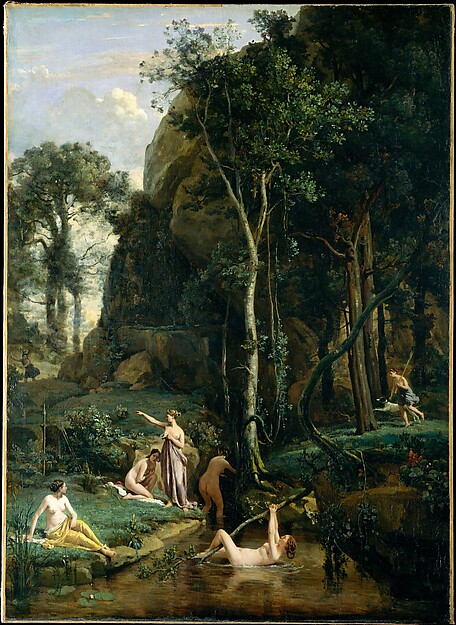
Diana and Actaeon (Diana Surprised in Her Bath)
1836 Artwork
Camille Corot
Robert Lehman Collection, 1975
Open at The Met -

Nymphs and Satyr
1873 Artwork
William-Adolphe Bouguereau
William-Adolphe Bouguereau (1825-1905) - Nymphs and Satyr (1873) HQ.jpg · Wikimedia Commons
Open at Wikidata -

Harpsichord
ca. 1670 Artwork
Michele Todini
The Crosby Brown Collection of Musical Instruments, 1889
Open at The Met -

Hylas and the Nymphs
1896 Artwork
John William Waterhouse
Waterhouse Hylas and the Nymphs Manchester Art Gallery 1896.15.jpg · Wikimedia Commons
Open at Wikidata -

Diana and her Nymphs
1650 Artwork
Johannes Vermeer
Johannes Vermeer - Diana and her Nymphs - 406 - Mauritshuis.jpg · Wikimedia Commons
Open at Wikidata -

The Bacchanal of the Andrians
1523 Artwork
Titian
Bacanal de los andrios.jpg · Wikimedia Commons
Open at Wikidata -

La Nymphe surprise
1860 Artwork
Édouard Manet
Edouard Manet Die ueberraschte Nymphe.jpg · Wikimedia Commons
Open at Wikidata -

Diana Bathing with her Nymphs with Actaeon and Callisto
1634 Artwork
Rembrandt
Rembrandt, Harmenszoon van Rijn - Diana mit Aktäon und Kallisto - c.1634-1635.jpg · Wikimedia Commons
Open at Wikidata -

The Fight Between Mars and Minerva
1771 Artwork
Jacques-Louis David
The Combat Of Mars And Minerva.jpg · Wikimedia Commons
Open at Wikidata
Held since 17 Sep 2026.
GIFs
 GIPHY

Looking for GIFs…
Fetched by your browser on this visit; nothing is stored here.
Search matches, not reviewed interpretations. Hover, focus or press Play to animate.
Matches for “nymph” · About these results
Artworks
Saved catalog · The Met, Wikidata
Catalog matches from The Met, Wikidata, held locally rather than searched for on this visit. None is an accepted interpretation: a contributor connects an exact meaning and reviewers decide the claim. Browse saved artworks
- Diana and Actaeon: Direct depiction of “nymph” (Q373916) tagged “Nymphs”. · not yet reviewed
- The Birth of Venus: Direct depiction of “nymph” (Q373916) tagged “nymph”. · not yet reviewed
- Diana and Actaeon (Diana Surprised in Her Bath): Direct depiction of “nymph” (Q373916) tagged “Nymphs”. · not yet reviewed
- Nymphs and Satyr: Direct depiction of “nymph” (Q373916) tagged “nymph”. · not yet reviewed
- Harpsichord: Direct depiction of “nymph” (Q373916) tagged “Nymphs”. · not yet reviewed
- Hylas and the Nymphs: Direct depiction of “nymph” (Q373916) tagged “nymph”. · not yet reviewed
- Diana and her Nymphs: Direct depiction of “nymph” (Q373916) tagged “nymph”. · not yet reviewed
- The Bacchanal of the Andrians: Direct depiction of “nymph” (Q373916) tagged “nymph”. · not yet reviewed
- La Nymphe surprise: Direct depiction of “nymph” (Q373916) tagged “nymph”. · not yet reviewed
- Diana Bathing with her Nymphs with Actaeon and Callisto: Direct depiction of “nymph” (Q373916) tagged “nymph”. · not yet reviewed
- The Fight Between Mars and Minerva: Direct depiction of “nymph” (Q373916) tagged “nymph”. · not yet reviewed
Subjects
1 subject · 0 addressed
Found by name and by the sources. Not reviewed: a shared name is not a shared identity.
Subject
nymph
minor female nature deity in Greek and Roman mythology; personifications of nature
Unclassified

nymph
minor female nature deity in Greek and Roman mythology; personifications of nature
Wikipedia Q373916 where this came from — the thing this word names — nymph
A nymph (Ancient Greek: νύμφη, romanized: nýmphē; Attic Greek: [nýmpʰɛː]; sometimes spelled nymphe) is a minor female nature deity in ancient Greek folklore. Distinct from other Greek goddesses, nymphs are generally regarded as personifications of nature; they are typically tied to a specific place, landform, or tree, and are usually depicted as maidens. Because of their association with springs, they were often seen as having healing properties; other divine powers of the nymphs included divination and shapeshifting.
… 946 more Fold this article
In spite of their divine nature, they were not immortal.
Nymphs are divided into various broad subgroups based on their habitat, such as the Meliae (ash tree nymphs), the Dryads (oak tree nymphs), the Alseids (grove nymphs), the Naiads (spring nymphs), the Nereids (sea nymphs), the Oceanids (ocean nymphs), and the Oreads (mountain nymphs). Other nymphs included the Hesperides (evening nymphs), the Hyades (rain nymphs), the Heliades (poplar tree nymphs, daughters of Helios), and the Pleiades (companions of Artemis).
Nymphs featured in classic works of art, literature, and mythology. They are often attendants of goddesses and frequently occur in myths with a love motif, being the lovers of heroes and other deities. Desirable and promiscuous, nymphs can rarely be tamed, their dealings with mortals often marked by capricious aggression. Since the Middle Ages, nymphs have been sometimes popularly associated or even confused with fairies.
 Wikipedia (English)
read this at Wikipedia (English)
where this came from — Wikipedia (English)
may also refer to
- nymph — minor female nature deity in Greek and Roman mythology; personifications of nature
Public linked claims
What the existing sources assert about these meanings. These are source claims, not curated endorsements.
-
Ide instance of nymph
Wikidata · assertion revision 1207962
Source, evidence and revision history -
nymph lexeme entity candidate nymph
Wikipedia (English) · assertion revision 1444629
Source, evidence and revision history -
(classical mythology) a minor nature goddess usually depicted as a beautiful maiden refers to nymph
Wikipedia (English) · assertion revision 4346130
Source, evidence and revision history
Sources
-
Samuel Johnson, A Dictionary of the English Language
Samuel Johnson
-
 The Met
-
Wikidata
Wikidata
-
Wikipedia (English)
Wikipedia (English)
-
Wiktionary (English) via Kaikki
Wiktionary (English) via Kaikki
-
Open English WordNet 2025
Open English WordNet 2025
-
GIPHY
GIPHY
-
Urban Dictionary
Urban Dictionary
8 sources on this page