All materials · Hermes
Search the dictionaries, texts, images and API records available for this entry. Source matches are not curated endorsements.
Return to the curated articleSource / API coverage for this entry
Counts above cover loaded, permitted materials. Unavailable or not-yet-loaded sources are not evidence of an empty catalogue. Browser-only results remain on your device.
- Bing News · not loaded for this entry
- CineGraph · not loaded for this entry
- Wikimedia Commons · not loaded for this entry
- GIPHY · browser results · inspect complete records for status
- The Guardian · not loaded for this entry
- The Met · not loaded for this entry
- Open Library · not loaded for this entry
- Openverse · not loaded for this entry
- Pexels · not loaded for this entry
- PoetryDB · not loaded for this entry
- Spotify · not loaded for this entry
- Unsplash · not loaded for this entry
- Wikiquote · not loaded for this entry
Inspect complete source records and provider status
Hermes
noun
Olympian god in Greek religion and mythology; the emissary and messenger of the gods; the god of trade, heraldry, merchants, commerce, roads, thieves, trickery, sports, travelers, and athletes; the son of Zeus and the Pleiad Maia Wikidata where this came from — Wikidata
Definitions
2 dictionaries
 Open English WordNet 2025
2025 ·
noun ·
1 sense
(Greek mythology) messenger and herald of the gods; god of commerce and cunning and invention and theft; identified with Roman Mercury
Open English WordNet 2025
2025 · noun · 1 sense
(Greek mythology) messenger and herald of the gods; god of commerce and cunning and invention and theft; identified with Roman Mercury
-
●
(Greek mythology) messenger and herald of the gods; god of commerce and cunning and invention and theft; identified with Roman Mercury
Read this at Open English WordNet 2025 where this came from — Open English WordNet 2025
 Wiktionary (English) via Kaikki
2026 ·
noun ·
1 sense
A head or bust on a square base, often double-faced.
Wiktionary (English) via Kaikki
2026 · noun · 1 sense
A head or bust on a square base, often double-faced.
-
1
A head or bust on a square base, often double-faced.
Read this at Wiktionary (English) via Kaikki where this came from — Wiktionary (English) via Kaikki
 Urban Dictionary
read this at Urban Dictionary
Asking Urban Dictionary…
Crowd-sourced and unreviewed. Fetched by your browser; nothing is stored here.
Out in the world
3 things · every match says why it is here
Artworks
3
Saved catalog
-

Terracotta aryballos (oil flask)
ca. 570 BCE Artwork
Nearchos
Purchase, The Cesnola Collection, by exchange, 1926
Open at The Met -

Terracotta bell-krater (bowl for mixing wine and water)
ca. 440 BCE Artwork
Persephone Painter
Fletcher Fund, 1928
Open at The Met
Held since 17 Sep 2026.
GIFs
 GIPHY

Looking for GIFs…
Fetched by your browser on this visit; nothing is stored here.
Search matches, not reviewed interpretations. Hover, focus or press Play to animate.
Matches for “Hermes” · About these results
Artworks
Saved catalog · The Met, Wikidata
Catalog matches from The Met, Wikidata, held locally rather than searched for on this visit. None is an accepted interpretation: a contributor connects an exact meaning and reviewers decide the claim. Browse saved artworks
- Terracotta aryballos (oil flask): Direct depiction of “Hermes” (Q41484) tagged “Hermes”. · not yet reviewed
- Primavera: Direct depiction of “Hermes” (Q41484) tagged “Hermes”. · not yet reviewed
- Terracotta bell-krater (bowl for mixing wine and water): Direct depiction of “Hermes” (Q41484) tagged “Hermes”. · not yet reviewed
Subjects
1 subject · 0 addressed
Found by name and by the sources. Not reviewed: a shared name is not a shared identity.
Subject
Hermes
Olympian god in Greek religion and mythology; the emissary and messenger of the gods; the god of trade, heraldry, merchants, commerce, roads, thieves, trickery, sports, travelers, and athletes; the son of Zeus and the Pleiad Maia
Unclassified
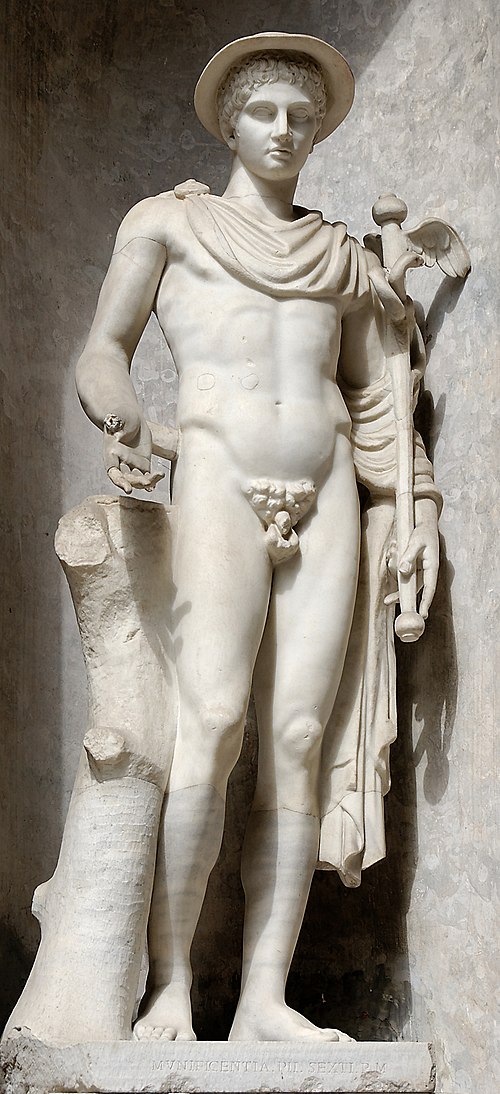
Hermes
Olympian god in Greek religion and mythology; the emissary and messenger of the gods; the god of trade, heraldry, merchants, commerce, roads, thieves, trickery, sports, travelers, and athletes; the son of Zeus and the Pleiad Maia
Wikipedia Q41484 where this came from — the thing this word names — Hermes
Hermes (; Ancient Greek: Ἑρμῆς) is an Olympian deity in ancient Greek religion and mythology considered the herald of the gods. He is also widely considered the protector of human heralds, travelers, thieves, merchants, and orators. He is able to move quickly and freely between the worlds of the mortal and the divine aided by his winged sandals. Hermes plays the role of the psychopomp or "soul guide"—a conductor of souls into the afterlife.
… 819 more Fold this article
In myth, Hermes functions as the emissary and messenger of the gods, and is often presented as the son of Zeus and Maia, the Pleiad. He is regarded as "the divine trickster", about which the Homeric Hymn to Hermes offers the most well-known account.
Hermes's attributes and symbols include the herma, the rooster, the tortoise, satchel or pouch, talaria (winged sandals), and winged helmet or simple petasos, as well as the palm tree, goat, the number four, several kinds of fish, and incense. However, his main symbol is the caduceus, a winged staff intertwined with two snakes copulating and carvings of the other gods.
In Roman mythology and religion many of Hermes's characteristics belong to Mercury, a name derived from the Latin merx, meaning "merchandise", and the origin of the words "merchant" and "commerce."
 Wikipedia (English)
read this at Wikipedia (English)
where this came from — Wikipedia (English)
Public linked claims
What the existing sources assert about these meanings. These are source claims, not curated endorsements.
-
(Greek mythology) messenger and herald of the gods; god of commerce and cunning and invention and theft; identified with Roman Mercury refers to Hermes
Open English WordNet 2025 · assertion revision 4358457
Source, evidence and revision history -
(Greek mythology) messenger and herald of the gods; god of commerce and cunning and invention and theft; identified with Roman Mercury refers to Hermes
Open English WordNet 2025 · assertion revision 4358674
Source, evidence and revision history
Sources
-
 The Met
-
 Wikidata
-
Wikipedia (English)
Wikipedia (English)
-
Wiktionary (English) via Kaikki
Wiktionary (English) via Kaikki
-
Open English WordNet 2025
Open English WordNet 2025
-
GIPHY
GIPHY
-
Urban Dictionary
Urban Dictionary
7 sources on this page