All materials · fuse
Search the dictionaries, texts, images and API records available for this entry. Source matches are not curated endorsements.
Return to the curated articleSource / API coverage for this entry
Counts above cover loaded, permitted materials. Unavailable or not-yet-loaded sources are not evidence of an empty catalogue. Browser-only results remain on your device.
- Bing News · not loaded for this entry
- CineGraph · not loaded for this entry
- Wikimedia Commons · not loaded for this entry
- GIPHY · browser results · inspect complete records for status
- The Guardian · not loaded for this entry
- The Met · not loaded for this entry
- Open Library · not loaded for this entry
- Openverse · not loaded for this entry
- Pexels · not loaded for this entry
- PoetryDB · not loaded for this entry
- Spotify · not loaded for this entry
- Unsplash · not loaded for this entry
- Wikiquote · not loaded for this entry
Inspect complete source records and provider status
Definitions
2 dictionaries
 Open English WordNet 2025
2025 ·
noun ·
2 senses
any igniter that is used to initiate the burning of a propellant
Open English WordNet 2025
2025 · noun · 2 senses
any igniter that is used to initiate the burning of a propellant
-
●
any igniter that is used to initiate the burning of a propellant
broader lighter device instrumentality artifact whole object physical entity entity
-
●
an electrical device that can interrupt the flow of electrical current when it is overloaded
broader electrical device device instrumentality artifact whole object physical entity entity
Read this at Open English WordNet 2025 where this came from — Open English WordNet 2025
 Wiktionary (English) via Kaikki
2026 ·
noun ·
7 senses
A device to prevent excessive overcurrent from overload or short circuit in an electrical circuit, containing a component that melts and interrupts the current when too high a load is passed through it.
Wiktionary (English) via Kaikki
2026 · noun · 7 senses
A device to prevent excessive overcurrent from overload or short circuit in an electrical circuit, containing a component that melts and interrupts the current when too high a load is passed through it.
-
1
A device to prevent excessive overcurrent from overload or short circuit in an electrical circuit, containing a component that melts and interrupts the current when too high a load is passed through it.
-
2
A wick or cord used to convey flame to gunpowder, a bomb, or similar explosive.
-
“The Government, having lit the fuse, is not going to be allowed to flee the explosion.”
1962 October, “Talking of Trains: Passed to you, Mr. Macmillan”, in Modern Railways, page 220
Wiktionary (English) via Kaikki
Plausible
-
-
3
An otherwise stable arbitrarily long repeating pattern that, when perturbed from one end, destructively carries that perturbation at a constant speed to the other end.
show 4 more
-
4
Alternative spelling of fuze, a detonator, any mechanism igniting an explosive substance or device. (alt-of, alternative, proscribed, sometimes)variants fuze
-
5
A tendency to lose one's temper. (figuratively)
-
6
A friction match for smokers' use, having a bulbous head which when ignited is not easily blown out even in a gale of wind.similar fusee
-
7
A match made of paper impregnated with niter and having the usual igniting tip.
Read this at Wiktionary (English) via Kaikki where this came from — Wiktionary (English) via Kaikki
 Urban Dictionary
read this at Urban Dictionary
Asking Urban Dictionary…
Crowd-sourced and unreviewed. Fetched by your browser; nothing is stored here.
Out in the world
every match says why it is here
GIFs
 GIPHY

Looking for GIFs…
Fetched by your browser on this visit; nothing is stored here.
Search matches, not reviewed interpretations. Hover, focus or press Play to animate.
Subjects
1 subject · 0 addressed
Found by name and by the sources. Not reviewed: a shared name is not a shared identity.
Subject
fuse
electrical safety device
Unclassified
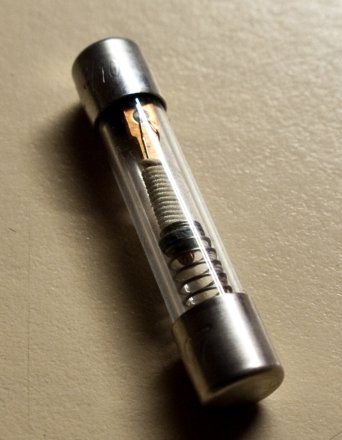
fuse
electrical safety device
Wikipedia Q182221 where this came from — the thing this word names — fuse
In electronics and electrical engineering, a fuse is an electrical safety device that operates to provide overcurrent protection of an electrical circuit. Its essential component is a metal wire or strip that melts when too much current flows through it, thereby stopping or interrupting the current. It is a sacrificial device; once a fuse has operated, it is an open circuit, and must be replaced or rewired, depending on its type.
… 1,033 more Fold this article
Fuses have been used as essential safety devices from the early days of electrical engineering. Today there are thousands of different fuse designs which have specific current and voltage ratings, breaking capacity, and response times, depending on the application. The time and current operating characteristics of fuses are chosen to provide adequate protection without needless interruption. Wiring regulations usually define a maximum fuse current rating for particular circuits. A fuse can be used to mitigate short circuits, overloading, mismatched loads, or device failure. When a damaged live wire makes contact with a metal case that is connected to ground, a short circuit will form and the fuse will melt.
A fuse is an automatic means of removing power from a faulty system, often abbreviated to ADS (automatic disconnection of supply). Circuit breakers have replaced fuses in many contexts, but have significantly different characteristics, and fuses are still used when space, resiliency or cost are significant factors.
 Wikipedia (English)
read this at Wikipedia (English)
where this came from — Wikipedia (English)
Public linked claims
What the existing sources assert about these meanings. These are source claims, not curated endorsements.
-
A device to prevent excessive overcurrent from overload or short circuit in an electrical circuit, containing a component that melts and interrupts the current when too high a load is passed through it. refers to fuse
Wiktionary (English) via Kaikki · assertion revision 3914970
Source, evidence and revision history
Sources
-
 Wikidata
-
Wikipedia (English)
Wikipedia (English)
-
Wiktionary (English) via Kaikki
Wiktionary (English) via Kaikki
-
Open English WordNet 2025
Open English WordNet 2025
-
GIPHY
GIPHY
-
Urban Dictionary
Urban Dictionary
6 sources on this page