All materials · vampire
Search the dictionaries, texts, images and API records available for this entry. Source matches are not curated endorsements.
Return to the curated articleSource / API coverage for this entry
Counts above cover loaded, permitted materials. Unavailable or not-yet-loaded sources are not evidence of an empty catalogue. Browser-only results remain on your device.
- Bing News · not loaded for this entry
- CineGraph · not loaded for this entry
- Wikimedia Commons · not loaded for this entry
- GIPHY · browser results · inspect complete records for status
- The Guardian · not loaded for this entry
- The Met · not loaded for this entry
- Open Library · not loaded for this entry
- Openverse · not loaded for this entry
- Pexels · not loaded for this entry
- PoetryDB · not loaded for this entry
- Spotify · not loaded for this entry
- Unsplash · not loaded for this entry
- Wikiquote · not loaded for this entry
Inspect complete source records and provider status
vampire
noun
mythological or folkloric creature Wikidata where this came from — Wikidata
Definitions
2 dictionaries
 Open English WordNet 2025
2025 ·
noun ·
1 sense
(folklore) a corpse that rises at night to drink the blood of the living
Open English WordNet 2025
2025 · noun · 1 sense
(folklore) a corpse that rises at night to drink the blood of the living
-
●
(folklore) a corpse that rises at night to drink the blood of the living
broader evil spirit spirit spiritual being belief content cognition psychological feature abstraction
Read this at Open English WordNet 2025 where this came from — Open English WordNet 2025
 Wiktionary (English) via Kaikki
2026 ·
noun ·
8 senses
A mythological creature (usually humanoid and undead) said to feed on the blood or life energy of the living.
Wiktionary (English) via Kaikki
2026 · noun · 8 senses
A mythological creature (usually humanoid and undead) said to feed on the blood or life energy of the living.
-
1
A mythological creature (usually humanoid and undead) said to feed on the blood or life energy of the living.
-
“[I]n the Village of Medreyga in Hungary, certain dead Bodies (call'd there Vampyres) had kill'd several Persons by sucking out all their Blood: That Arnold Paul, an Heyduke, having kill'd four Persons after he was dead, his Body was taken up 40 Days after, which bled at the Nose, Mouth and Ears: That, according to Custom, they drove a Stake thro' his Heart, at which he gave horrid Groan, and lost a great deal of Blood. And that all such as have been tormented or kill'd by Vampyres, become Vampyres when they are dead.”
1732 May 20, The London Journal, page 76, column 1
Wiktionary (English) via Kaikki
Plausible
-
“The universal belief is, that a person sucked by a vampyre becomes a vampyre himself, and sucks in his turn.”
1819, John William Polidori, The Vampyre, London: Sherwood, Neely, and Jones, page xxi
Wiktionary (English) via Kaikki
Plausible
2 more quotations for this sense
-
“From my laboratory in the Castle east To the master bedroom, where the vampires feast The ghouls all came from their humble abodes To get a jolt from my electrodes They did the Mash They did the Monster Mash.”
1962, “Monster Mash”, Bobby "Boris" Pickett and Lenny Capizzi (lyrics), performed by Bobby (Boris) Pickett and The Crypt-Kickers
Wiktionary (English) via Kaikki
Plausible
-
“I'm a vampire, baby, sucking blood from the earth / Well, I'm a vampire, baby, sell you twenty barrels worth”
1974, Neil Young, “Vampire Blues”, in On the Beach
Wiktionary (English) via Kaikki
Plausible
-
-
2
A person with habits traditionally ascribed to (literal) vampires, such as heliophobia, being a night owl, having pale skin, and so on. (colloquial, humorous, usually)
-
3
A person with the medical condition porphyria cutanea tarda, colloquially known as vampirism, with effects such as photosensitivity and brownish-red stained teeth. (colloquial, offensive)
show 5 more
-
4
A blood-sucking bat; vampire bat (Desmodus rotundus)similar vampire bat
-
5
A person who drains one's time, energy, money, etc. (derogatory, figuratively)
-
6
A vamp: a seductive woman who exploits men. (dated)
-
“"What followed this decision was exactly what we had expected: Mr. Fox, realizing that the public was tiring of Theda Bara in vampire roles, announced that he would star her in a production of Romeo and Juliet," she illustrated.”
2004, David W. Menefee, The First Female Stars: Women of the Silent Era, page 4
Wiktionary (English) via Kaikki
Plausible
-
-
7
A medical technician who works with patients' blood; especially, a phlebotomist. (US, slang)
-
“Only one technician in the hospital lab, in all we have encountered, uses it. […] Eric makes no complaints other than those directed at the vampires. Brenda and I do.”
1992, Terry Pringle, This is the Child
Wiktionary (English) via Kaikki
Plausible
-
“"I draw blood from patients, and then I take it back to the lab and analyze it. Sometimes, the vampires do all the sticks, that is to say the lab assistants do all the blood collections." He grinned. "We have our own language at the lab."”
2000, Tracie Peterson, Colorado Wings, page 373
Wiktionary (English) via Kaikki
Plausible
-
-
8
Synonym of anti-ship missile (ASM), particularly an incoming hostile one. (US, slang)similar anti-ship missile
Read this at Wiktionary (English) via Kaikki where this came from — Wiktionary (English) via Kaikki
 Urban Dictionary
read this at Urban Dictionary
Asking Urban Dictionary…
Crowd-sourced and unreviewed. Fetched by your browser; nothing is stored here.
Out in the world
1 things · every match says why it is here
Artworks
1
Saved catalog
For the word “vampire”, not a particular sense.
-

Vampire
1893 Artwork
Edvard Munch
Edvard Munch - Vampire - MM.M.00292 - Munch Museum.jpg · Wikimedia Commons
Open at Wikidata
Held since 17 Sep 2026.
GIFs
 GIPHY

Looking for GIFs…
Fetched by your browser on this visit; nothing is stored here.
Search matches, not reviewed interpretations. Hover, focus or press Play to animate.
Matches for “vampire” · About these results
Artworks
Saved catalog · Wikidata
Catalog matches from Wikidata, held locally rather than searched for on this visit. None is an accepted interpretation: a contributor connects an exact meaning and reviewers decide the claim. Browse saved artworks
- Vampire: Related depiction of “vampire” (Q46721) tagged “vampire”. For the word “vampire”, not a particular sense. · not yet reviewed
Subjects
2 subjects · 0 addressed
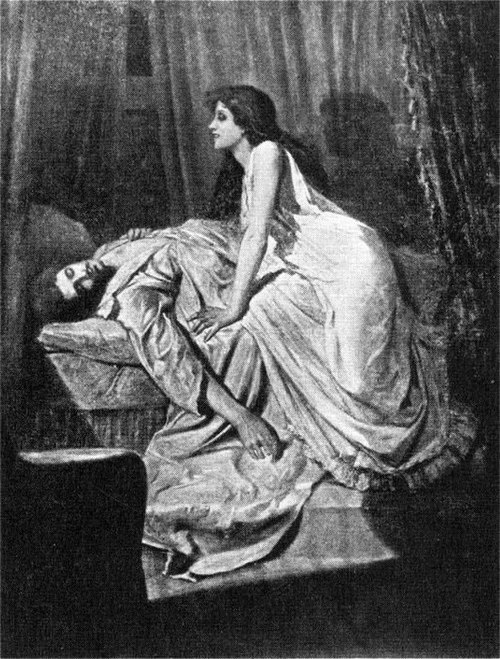
vampire
mythological or folkloric creature
Wikipedia Q46721 where this came from — the thing this word names — vampire
A vampire is a mythical creature with a human-like appearance that subsists by feeding on the vital essence (usually the blood) of humans. In European folklore, vampires are undead humanoid creatures that visit loved ones and cause mischief or deaths in the neighbourhoods they inhabited while they were alive. They wear shrouds and are often described as bloated and of ruddy or dark countenance, contrasting with the modern gaunt, pale vampire which dates from the early 19th century.
… 1,966 more Fold this article
Vampiric entities have been recorded in cultures around the world, but the term vampire was first popularized in Western Europe following reports of an 18th-century mass hysteria drawing on a pre-existing folk belief in Southeastern and Eastern Europe. This delusion led, in certain cases, not only to individuals being accused of vampirism, but also to the corpses of such suspected vampires being pierced with stakes.
Local variants in Southeastern Europe were also known by different names, such as shtriga in Albania, vrykolakas in Greece and strigoi in Romania, cognate with Italian strega, meaning 'witch'.
In modern times, the vampire is generally held to be a fictitious entity, although belief in similar vampiric creatures (such as the chupacabra) still persists in some cultures. Early folk belief in vampires has sometimes been ascribed to the ignorance of the body's process of decomposition after death and how people in pre-industrial societies tried to rationalize this, creating the figure of the vampire to explain the mysteries of death. In 1982, scientist David Dolphin suggested that Porphyria was linked with legends of both vampirism and werewolves, receiving much media exposure. This theory has since been largely discredited.
The charismatic and sophisticated vampire of modern fiction was born in 1819 with the publication of "The Vampyre" by the English writer John Polidori; the story was highly successful and arguably the most influential vampire work of the early 19th century. Bram Stoker's 1897 novel Dracula is remembered as the quintessential vampire novel and provided the basis of the modern vampire legend, even though it was published after fellow Irish author Joseph Sheridan Le Fanu's 1872 novel Carmilla. The success of this book spawned a distinctive vampire genre, still popular in the 21st century, with books, films, television shows, and video games. The vampire has since become a dominant figure in the horror genre.
 Wikipedia (English)
read this at Wikipedia (English)
where this came from — Wikipedia (English)
a kind of mythical monster
may also refer to
- vampire — mythological or folkloric creature
Public linked claims
What the existing sources assert about these meanings. These are source claims, not curated endorsements.
-
vampire lexeme entity candidate vampire
Wikipedia (English) · assertion revision 1444864
Source, evidence and revision history
Sources
-
 Wikidata
-
Wikipedia (English)
Wikipedia (English)
-
Wiktionary (English) via Kaikki
Wiktionary (English) via Kaikki
-
Open English WordNet 2025
Open English WordNet 2025
-
GIPHY
GIPHY
-
Urban Dictionary
Urban Dictionary
6 sources on this page