All materials · hare
Search the dictionaries, texts, images and API records available for this entry. Source matches are not curated endorsements.
Return to the curated articleSource / API coverage for this entry
Counts above cover loaded, permitted materials. Unavailable or not-yet-loaded sources are not evidence of an empty catalogue. Browser-only results remain on your device.
- Bing News · not loaded for this entry
- CineGraph · not loaded for this entry
- Wikimedia Commons · not loaded for this entry
- GIPHY · browser results · inspect complete records for status
- The Guardian · not loaded for this entry
- The Met · not loaded for this entry
- Open Library · not loaded for this entry
- Openverse · not loaded for this entry
- Pexels · not loaded for this entry
- PoetryDB · not loaded for this entry
- Spotify · not loaded for this entry
- Unsplash · not loaded for this entry
- Wikiquote · not loaded for this entry
Inspect complete source records and provider status
hare
+7 variants
- /hɜː(ɹ)/
- /hiə/
- [heːɾ] Scotland
- /heː/ Australia
- /heə/ New-Zealand
- /heɾ/ Scotland
- /hɛː/ Received-Pronunciation
- /hɛə/ Received-Pronunciation
- /hɛɚ/ General-American
- recording US
noun
genus of mammals in the family Leporidae Wikidata where this came from — Wikidata
Definitions
3 dictionaries
 Samuel Johnson
18th century ·
1755 ·
noun ·
623 characters
1. A small quadruped, with long ears and short tail, that moves by leaps, remarkable for timidity, vigilance, and fecundity; the common game of hunters. Dismay'd not this Our captains Macbeth and Banquo? ——Yes, As sparro
Samuel Johnson
18th century · 1755 · noun · 623 characters
1. A small quadruped, with long ears and short tail, that moves by leaps, remarkable for timidity, vigilance, and fecundity; the common game of hunters. Dismay'd not this Our captains Macbeth and Banquo? ——Yes, As sparro
1. A small quadruped, with long ears and short tail, that moves by leaps, remarkable for timidity, vigilance, and fecundity; the common game of hunters.
Dismay'd not this
Our captains Macbeth and Banquo?
——Yes,
As sparrows, eagles; or the hare, the lion. Shakesp. Macb.
We view in the open champaign a brace of swift greyhounds coursing a good stout and well breathed hare. More.
Read the rest of this entry · 240 characters Fold this entry
Your dressings must be with Galen's powder and hare's fur.
Wiseman's Surgery.
Poor is the triumph o'er the timid hare. Thoms. Autumn.
2. A constellation.
The hare appears, whose active rays supply
A nimble force, and hardly wings deny. Creech.
Read this at Samuel Johnson where this came from — Samuel Johnson, A Dictionary of the English Language
 Open English WordNet 2025
2025 ·
noun ·
2 senses
swift timid long-eared mammal larger than a rabbit having a divided upper lip and long hind legs; young born furred and with open eyes
Open English WordNet 2025
2025 · noun · 2 senses
swift timid long-eared mammal larger than a rabbit having a divided upper lip and long hind legs; young born furred and with open eyes
- ●
broader leporid lagomorph placental mammal vertebrate chordate animal organism
-
●
flesh of any of various rabbits or hares (wild or domesticated) eaten as food
broader game meat solid food food substance matter physical entity entity
Read this at Open English WordNet 2025 where this came from — Open English WordNet 2025
 Wiktionary (English) via Kaikki
2026 ·
noun ·
3 senses
Any of several plant-eating mammals of the genus Lepus, similar to a rabbit, but larger and with longer ears.
Wiktionary (English) via Kaikki
2026 · noun · 3 senses
Any of several plant-eating mammals of the genus Lepus, similar to a rabbit, but larger and with longer ears.
-
1
Any of several plant-eating mammals of the genus Lepus, similar to a rabbit, but larger and with longer ears. (countable)
-
“The hare has a reputation for exciting desire. Hare soup is credited with a particular aphrodisiac value.”
1961, Harry E. Wedeck, Dictionary of Aphrodisiacs, New York: The Citadel Press, page 111
Wiktionary (English) via Kaikki
Plausible
-
-
2
The meat from this animal. (uncountable)
-
“Ashe bit absent-mindedly into a piece of hare and swore mildly when he burned his tongue.”
1958, Andre Norton, The Time Traders, Cleveland, Oh.; New York, N.Y.: The World Publishing Company, →LCCN, page 79
Wiktionary (English) via Kaikki
Plausible
-
“Hare is another delicious meat – it’s more ‘steaky’, darker and richer than rabbit.”
2007, Jamie Oliver, Jamie at Home: Cook Your Way to the Good Life, London: Michael Joseph, Penguin Books, →ISBN, page 273
Wiktionary (English) via Kaikki
Plausible
1 more quotation for this sense
-
“In Milan, jugged hare is flavoured with grated chocolate, which adds colour and depth to the sauce.”
2013, Anna Del Conte, Gastronomy of Italy, London: Pavilion, →ISBN, page 109
Wiktionary (English) via Kaikki
Plausible
-
-
3
The player in a paperchase, or hare and hounds game, who leaves a trail of paper to be followed. (countable)
Read this at Wiktionary (English) via Kaikki where this came from — Wiktionary (English) via Kaikki
 Urban Dictionary
read this at Urban Dictionary
Asking Urban Dictionary…
Crowd-sourced and unreviewed. Fetched by your browser; nothing is stored here.
Out in the world
every match says why it is here
GIFs
 GIPHY

Looking for GIFs…
Fetched by your browser on this visit; nothing is stored here.
Search matches, not reviewed interpretations. Hover, focus or press Play to animate.
Subjects
2 subjects · 0 addressed
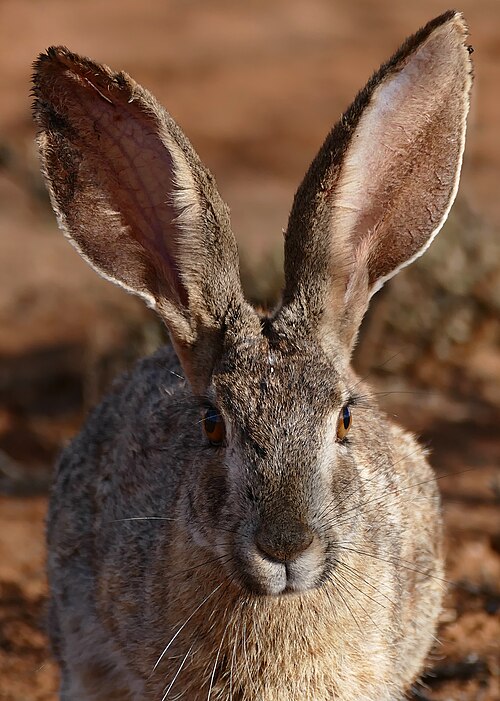
hare
genus of mammals in the family Leporidae
Lepus
Wikipedia Q46076 where this came from — the thing this word names — hare
Hares are mammals belonging to the genus Lepus. They are herbivores and live solitarily or in pairs. They nest in depressions in the ground called forms, and their young are able to fend for themselves shortly after birth. The genus includes the largest lagomorphs. Most are fast runners with long, powerful hind legs, and large ears that dissipate body heat. Hare species are native to Africa, Eurasia and North America.
… 665 more Fold this article
A hare less than one year old is called a leveret. A group of hares may be called either a husk or a down.
Members of the Lepus genus are considered true hares, distinguishing them from rabbits which make up the rest of the Leporidae family. There are five species with common names that include the word "hare" which are not considered true hares: the hispid hare, and four species known as red rock hares (belonging to the genus Pronolagus). Conversely, several Lepus species are called "jackrabbits", but classed as hares rather than rabbits. The pet known as the Belgian hare is a domesticated European rabbit which has been selectively bred to resemble a hare.
 Wikipedia (English)
read this at Wikipedia (English)
where this came from — Wikipedia (English)
a kind of Leporidae Lagomorpha Glires Gliriformes Euarchontoglires Boreoeutheria placental eutherian mammal
may also refer to
- hare — genus of mammals in the family Leporidae
Public linked claims
What the existing sources assert about these meanings. These are source claims, not curated endorsements.
-
Any of several plant-eating mammals of the genus Lepus, similar to a rabbit, but larger and with longer ears. refers to hare
Wiktionary (English) via Kaikki · assertion revision 3860951
Source, evidence and revision history -
hare lexeme entity candidate hare
Wikipedia (English) · assertion revision 1441140
Source, evidence and revision history
Sources
-
Samuel Johnson, A Dictionary of the English Language
Samuel Johnson
-
 Wikidata
-
Wikipedia (English)
Wikipedia (English)
-
Wiktionary (English) via Kaikki
Wiktionary (English) via Kaikki
-
Open English WordNet 2025
Open English WordNet 2025
-
GIPHY
GIPHY
-
Urban Dictionary
Urban Dictionary
7 sources on this page