All materials · baboon
Search the dictionaries, texts, images and API records available for this entry. Source matches are not curated endorsements.
Return to the curated articleSource / API coverage for this entry
Counts above cover loaded, permitted materials. Unavailable or not-yet-loaded sources are not evidence of an empty catalogue. Browser-only results remain on your device.
- Bing News · not loaded for this entry
- CineGraph · not loaded for this entry
- Wikimedia Commons · not loaded for this entry
- GIPHY · browser results · inspect complete records for status
- The Guardian · not loaded for this entry
- The Met · not loaded for this entry
- Open Library · not loaded for this entry
- Openverse · not loaded for this entry
- Pexels · not loaded for this entry
- PoetryDB · not loaded for this entry
- Spotify · not loaded for this entry
- Unsplash · not loaded for this entry
- Wikiquote · not loaded for this entry
Inspect complete source records and provider status
Definitions
3 dictionaries
 Samuel Johnson
18th century ·
1755 ·
noun ·
218 characters
A monkey of the largest kind. You had looked through the grate like a geminy of baboons. Shakesp. Merry Wives of Windsor. He cast every human feature out of his countenance, and became a baboon. Addison. Spect. No 174.
Samuel Johnson
18th century · 1755 · noun · 218 characters
A monkey of the largest kind. You had looked through the grate like a geminy of baboons. Shakesp. Merry Wives of Windsor. He cast every human feature out of his countenance, and became a baboon. Addison. Spect. No 174.
A monkey of the largest kind.
You had looked through the grate like a geminy of baboons.
Shakesp. Merry Wives of Windsor.
He cast every human feature out of his countenance, and
became a baboon. Addison. Spect. No 174.
Read this at Samuel Johnson where this came from — Samuel Johnson, A Dictionary of the English Language
 Open English WordNet 2025
2025 ·
noun ·
1 sense
large terrestrial monkeys having doglike muzzles
Open English WordNet 2025
2025 · noun · 1 sense
large terrestrial monkeys having doglike muzzles
-
●
large terrestrial monkeys having doglike muzzles
broader Old World monkey monkey primate placental mammal vertebrate chordate animal
Read this at Open English WordNet 2025 where this came from — Open English WordNet 2025
 Wiktionary (English) via Kaikki
2026 ·
noun ·
3 senses
An Old World monkey of the genus Papio, having dog-like muzzles and large canine teeth, cheek pouches, a short tail, and naked callosities on the buttocks.
Wiktionary (English) via Kaikki
2026 · noun · 3 senses
An Old World monkey of the genus Papio, having dog-like muzzles and large canine teeth, cheek pouches, a short tail, and naked callosities on the buttocks.
-
1
An Old World monkey of the genus Papio, having dog-like muzzles and large canine teeth, cheek pouches, a short tail, and naked callosities on the buttocks.
-
“Mix swallowed the comment he wanted to make, that the council hall stank like a congress of baboons. But he was in no position to insult his host, nor should he. The man was only expressing the attitude of his time.”
1971, Philip José Farmer, Down in the Black Gang: and others; a story collection, Nelson Doubleday, page 79
Wiktionary (English) via Kaikki
Plausible
-
“He draws eclectically on studies of baboons, descriptive anthropological accounts of hunter-gatherer societies and, in a few cases, the fossil record.”
2012 March-April, John T. Jost, “Social Justice: Is It in Our Nature (and Our Future)?”, in American Scientist, volume 100, number 2, archived from the original on 21 Jun 2017, page 162
Wiktionary (English) via Kaikki
Plausible
-
-
2
A foolish, stupid or incompetent person. (colloquial, derogatory)
-
3
A black person. (colloquial, derogatory, ethnic, offensive, slur)
-
“The 50-year-old steel worker said he had meant to type Sawyers should win the "buffoon d'Or". He claimed a misspelling, of "bafoon", had autocorrected on his device to "baboon".”
2021 November, “Romaine Sawyers: Albion fan jailed for racist post loses appeal”, in BBC
Wiktionary (English) via Kaikki
Plausible
-
“Animalistic dehumanisation, 'simianisation' and the animalising of black bodies through metaphorically likening these individuals to 'baboons,' 'monkeys' or 'apes' reveals racialised animality discourse in South Africa.”
2022 October, René Cornish, Kieran Tranter, “Dismissals for Social Media Hate Speech in South Africa: Animalistic Dehumanisation and the Circulation of Racist Words and Images”, in Springer Nature Link
Wiktionary (English) via Kaikki
Plausible
-
Read this at Wiktionary (English) via Kaikki where this came from — Wiktionary (English) via Kaikki
 Urban Dictionary
read this at Urban Dictionary
Asking Urban Dictionary…
Crowd-sourced and unreviewed. Fetched by your browser; nothing is stored here.
Out in the world
1 things · every match says why it is here
Artworks
1
Saved catalog
For the word “baboon”, not a particular sense.
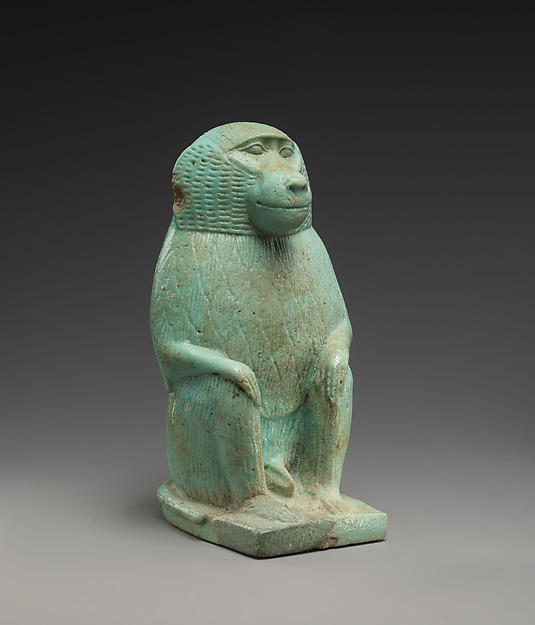
Held since 17 Sep 2026.
GIFs
 GIPHY

Looking for GIFs…
Fetched by your browser on this visit; nothing is stored here.
Search matches, not reviewed interpretations. Hover, focus or press Play to animate.
Matches for “baboon” · About these results
Artworks
Saved catalog · The Met
Catalog matches from The Met, held locally rather than searched for on this visit. None is an accepted interpretation: a contributor connects an exact meaning and reviewers decide the claim. Browse saved artworks
- Figure of a Baboon: Related depiction of “Papio” (Q159429) tagged “Baboons”. For the word “baboon”, not a particular sense. · not yet reviewed
Subjects
1 subject · 0 addressed
Found by name and by the sources. Not reviewed: a shared name is not a shared identity.
Subject
Papio
genus of mammals
Unclassified

Papio
genus of mammals
Papio
Wikipedia Q159429 where this came from — the thing this word names — Papio
Baboons are primates comprising the genus Papio, one of the 23 genera of Old World monkeys, in the family Cercopithecidae. There are six species of baboon: the hamadryas baboon, the Guinea baboon, the olive baboon, the yellow baboon, the Kinda baboon and the chacma baboon. Each species is native to one of six areas of Africa and the hamadryas baboon is also native to part of the Arabian Peninsula.
… 1,901 more Fold this article
Baboons are among the largest non-hominoid primates and have existed for at least two million years.
Baboons vary in size and weight depending on the species. The smallest, the Kinda baboon, is 50 cm (20 in) in length and weighs only 14 kg (31 lb), while the largest, the chacma baboon, is up to 120 cm (47 in) in length and weighs 40 kg (88 lb). All baboons have long, dog-like muzzles, heavy, powerful jaws with sharp canine teeth, close-set eyes, thick fur except on their muzzles, short tails, and nerveless, hairless pads of skin on their protruding buttocks called ischial callosities that provide for sitting comfort. Male hamadryas baboons have large white manes. Baboons exhibit sexual dimorphism in size, colour, and canine teeth development.
Baboons are diurnal and terrestrial, but sleep in trees, or on high cliffs or rocks at night, away from predators. They are found in open savannas and woodlands across Africa. They are omnivorous and their diet consists of a variety of plants and animals. Their principal predators are Nile crocodiles, leopards, lions and hyenas. Most baboons live in hierarchical troops containing harems. Baboons can determine from vocal exchanges what the dominance relations are between individuals.
In general, each male can mate with any female; the mating order among the males depends partly on their social rank. Females typically give birth after a six-month gestation, usually to one infant. The females tend to be the primary caretaker of the young, although several females may share the duties for all of their offspring. Offspring are weaned after about a year. They reach sexual maturity around five to eight years. Males leave their birth group, usually before they reach sexual maturity, whereas most females stay in the same group for their lives. Baboons in captivity live up to 45 years, while in the wild they average between 20 and 30 years.
 Wikipedia (English)
read this at Wikipedia (English)
where this came from — Wikipedia (English)
a kind of Cercopithecinae family Cercopithecidae Cercopithecoidea catarrhine simian haplorrhine order Primates Primatomorpha
may also refer to
- Papio — genus of mammals
Public linked claims
What the existing sources assert about these meanings. These are source claims, not curated endorsements.
-
baboon lexeme entity candidate Papio
Wikipedia (English) · assertion revision 1441147
Source, evidence and revision history
Sources
-
Samuel Johnson, A Dictionary of the English Language
Samuel Johnson
-
 The Met
-
 Wikidata
-
Wikipedia (English)
Wikipedia (English)
-
Wiktionary (English) via Kaikki
Wiktionary (English) via Kaikki
-
Open English WordNet 2025
Open English WordNet 2025
-
GIPHY
GIPHY
-
Urban Dictionary
Urban Dictionary
8 sources on this page