All materials · ganoid
Search the dictionaries, texts, images and API records available for this entry. Source matches are not curated endorsements.
Return to the curated articleSource / API coverage for this entry
Counts above cover loaded, permitted materials. Unavailable or not-yet-loaded sources are not evidence of an empty catalogue. Browser-only results remain on your device.
- Bing News · not loaded for this entry
- CineGraph · not loaded for this entry
- Wikimedia Commons · not loaded for this entry
- GIPHY · browser results · inspect complete records for status
- The Guardian · not loaded for this entry
- The Met · not loaded for this entry
- Open Library · not loaded for this entry
- Openverse · not loaded for this entry
- Pexels · not loaded for this entry
- PoetryDB · not loaded for this entry
- Spotify · not loaded for this entry
- Unsplash · not loaded for this entry
- Wikiquote · not loaded for this entry
Inspect complete source records and provider status
ganoid
noun
small rigid plate that grows out of the skin of a fish Wikidata where this came from — Wikidata
Definitions
2 dictionaries
 Open English WordNet 2025
2025 ·
noun ·
1 sense
primitive fishes having thick bony scales with a shiny covering
Open English WordNet 2025
2025 · noun · 1 sense
primitive fishes having thick bony scales with a shiny covering
-
●
primitive fishes having thick bony scales with a shiny coveringpart of Ganoidei
broader teleost fish bony fish fish aquatic vertebrate vertebrate chordate animal organism
Read this at Open English WordNet 2025 where this came from — Open English WordNet 2025
 Wiktionary (English) via Kaikki
2026 ·
noun ·
1 sense
One of the Ganoidei, a disused taxonomic grouping of fishes, including the bowfin, gars, and sturgeons.
Wiktionary (English) via Kaikki
2026 · noun · 1 sense
One of the Ganoidei, a disused taxonomic grouping of fishes, including the bowfin, gars, and sturgeons.
-
1
One of the Ganoidei, a disused taxonomic grouping of fishes, including the bowfin, gars, and sturgeons.
Read this at Wiktionary (English) via Kaikki where this came from — Wiktionary (English) via Kaikki
 Urban Dictionary
read this at Urban Dictionary
Asking Urban Dictionary…
Crowd-sourced and unreviewed. Fetched by your browser; nothing is stored here.
Out in the world
every match says why it is here
GIFs
 GIPHY

Looking for GIFs…
Fetched by your browser on this visit; nothing is stored here.
Search matches, not reviewed interpretations. Hover, focus or press Play to animate.
Subjects
1 subject · 0 addressed
Found by name and by the sources. Not reviewed: a shared name is not a shared identity.
Subject
fish scale
small rigid plate that grows out of the skin of a fish
Unclassified
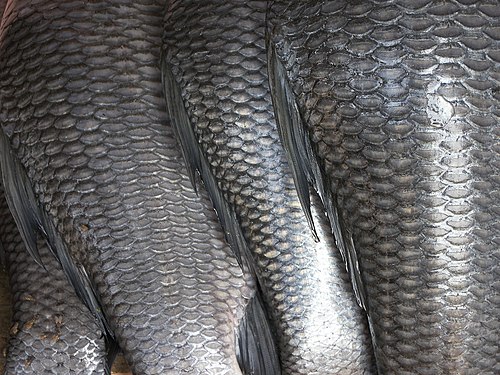
fish scale
small rigid plate that grows out of the skin of a fish
Wikipedia Q5454665 where this came from — the thing this word names — fish scale
A fish scale is a small rigid plate that grows out of the skin of a fish. The skin of most jawed fishes is covered with these protective scales, which can also provide effective camouflage through the use of reflection and colouration, as well as possible hydrodynamic advantages. The term scale derives from the Old French escale, meaning a shell pod or husk.
… 1,289 more Fold this article
Scales vary enormously in size, shape, structure, and extent, ranging from strong and rigid armour plates in fishes such as shrimpfishes and boxfishes, to microscopic or absent in fishes such as eels and anglerfishes. The morphology of a scale can be used to identify the species of fish it came from. Scales originated within the jawless ostracoderms, ancestors to all jawed fishes today. Most bony fishes are covered with the cycloid scales of salmon and carp, the ctenoid scales of perch, or the ganoid scales of sturgeons and gars. Cartilaginous fishes (sharks and rays) are covered with placoid scales. Some species are covered instead by scutes, and others have no outer covering on part or all of the skin.
Fish scales are part of the fish's integumentary system, and are produced from the mesoderm layer of the dermis, which distinguishes them from reptile scales. The same genes involved in tooth and hair development in mammals are also involved in scale development. The placoid scales of cartilaginous fishes are also called dermal denticles and are structurally homologous with vertebrate teeth. Most fish are also covered in a layer of mucus or slime which can protect against pathogens such as bacteria, fungi, and viruses, and reduce surface resistance when the fish swims.
 Wikipedia (English)
read this at Wikipedia (English)
where this came from — Wikipedia (English)
a kind of scale
may also refer to
- fish scale — small rigid plate that grows out of the skin of a fish
Public linked claims
What the existing sources assert about these meanings. These are source claims, not curated endorsements.
-
ganoid lexeme entity candidate fish scale
Wikipedia (English) · assertion revision 1443760
Source, evidence and revision history -
primitive fishes having thick bony scales with a shiny covering refers to fish scale
Wikipedia (English) · assertion revision 4344630
Source, evidence and revision history
Sources
-
 Wikidata
-
Wikipedia (English)
Wikipedia (English)
-
Wiktionary (English) via Kaikki
Wiktionary (English) via Kaikki
-
Open English WordNet 2025
Open English WordNet 2025
-
GIPHY
GIPHY
-
Urban Dictionary
Urban Dictionary
6 sources on this page