All materials · wasp
Search the dictionaries, texts, images and API records available for this entry. Source matches are not curated endorsements.
Return to the curated articleSource / API coverage for this entry
Counts above cover loaded, permitted materials. Unavailable or not-yet-loaded sources are not evidence of an empty catalogue. Browser-only results remain on your device.
- Bing News · not loaded for this entry
- CineGraph · not loaded for this entry
- Wikimedia Commons · not loaded for this entry
- GIPHY · browser results · inspect complete records for status
- The Guardian · not loaded for this entry
- The Met · not loaded for this entry
- Open Library · not loaded for this entry
- Openverse · not loaded for this entry
- Pexels · not loaded for this entry
- PoetryDB · not loaded for this entry
- Spotify · not loaded for this entry
- Unsplash · not loaded for this entry
- Wikiquote · not loaded for this entry
Inspect complete source records and provider status
wasp
+2 variants
- /waps/
- /wæsp/ obsolete
- /wɑsp/ General-American
- /wɒsp/ Received-Pronunciation
- recording US
noun
members of the order Hymenoptera Wikidata where this came from — Wikidata
Definitions
3 dictionaries
 Samuel Johnson
18th century ·
1755 ·
noun ·
355 characters
A brisk stinging infect, in form resembling a bee. More wasps, that buz about his nose, Will make this sting the sooner. Shakespeare's Henry VIII. Encount'ring with a wasp, He in his arms the fly doth clasp. Drayton. Why
Samuel Johnson
18th century · 1755 · noun · 355 characters
A brisk stinging infect, in form resembling a bee. More wasps, that buz about his nose, Will make this sting the sooner. Shakespeare's Henry VIII. Encount'ring with a wasp, He in his arms the fly doth clasp. Drayton. Why
A brisk stinging infect, in form resembling a bee.
More wasps, that buz about his nose,
Will make this sting the sooner. Shakespeare's Henry VIII.
Encount'ring with a wasp,
He in his arms the fly doth clasp. Drayton.
Why, what a wasp-tongu'd and impatient
Art thou, to break into this woman's mood,
Tying thine ear to no tongue but thine own? Shak. H. IV.
Read this at Samuel Johnson where this came from — Samuel Johnson, A Dictionary of the English Language
 Open English WordNet 2025
2025 ·
noun ·
1 sense
social or solitary hymenopterans typically having a slender body with the abdomen attached by a narrow stalk and having a formidable sting
Open English WordNet 2025
2025 · noun · 1 sense
social or solitary hymenopterans typically having a slender body with the abdomen attached by a narrow stalk and having a formidable sting
-
●
social or solitary hymenopterans typically having a slender body with the abdomen attached by a narrow stalk and having a formidable sting
broader hymenopterous insect insect arthropod invertebrate animal organism living thing whole
Read this at Open English WordNet 2025 where this came from — Open English WordNet 2025
 Wiktionary (English) via Kaikki
2026 ·
noun ·
5 senses
Any of many types of stinging flying insect resembling a hornet.
Wiktionary (English) via Kaikki
2026 · noun · 5 senses
Any of many types of stinging flying insect resembling a hornet.
-
1
Any of many types of stinging flying insect resembling a hornet.
-
2
Alternative letter-case form of WASP (“white Anglo-Saxon Protestant”). (alt-of)
-
“The show went through clothes to suit the lifestyle of a wealthy wasp, an American archetype that is now synonymous with the brand.”
2026 January 17, Lauren Cochrane, “Paul Smith reworks his past at Milan menswear salon show”, in The Guardian, →ISSN, archived from the original on 17 Jan 2026
Wiktionary (English) via Kaikki
Plausible
variants WASP -
-
3
Any of the members of suborder Apocrita, excepting the ants (family Formicidae) and bees (clade Anthophila).
show 2 more
-
4
Any of the members of the family Vespidae.
-
5
A person who behaves in an angry or insolent way, hence waspishly.
Read this at Wiktionary (English) via Kaikki where this came from — Wiktionary (English) via Kaikki
 Urban Dictionary
read this at Urban Dictionary
Asking Urban Dictionary…
Crowd-sourced and unreviewed. Fetched by your browser; nothing is stored here.
Out in the world
every match says why it is here
GIFs
 GIPHY

Looking for GIFs…
Fetched by your browser on this visit; nothing is stored here.
Search matches, not reviewed interpretations. Hover, focus or press Play to animate.
Subjects
1 subject · 0 addressed
Found by name and by the sources. Not reviewed: a shared name is not a shared identity.
Subject
wasps
members of the order Hymenoptera
Unclassified
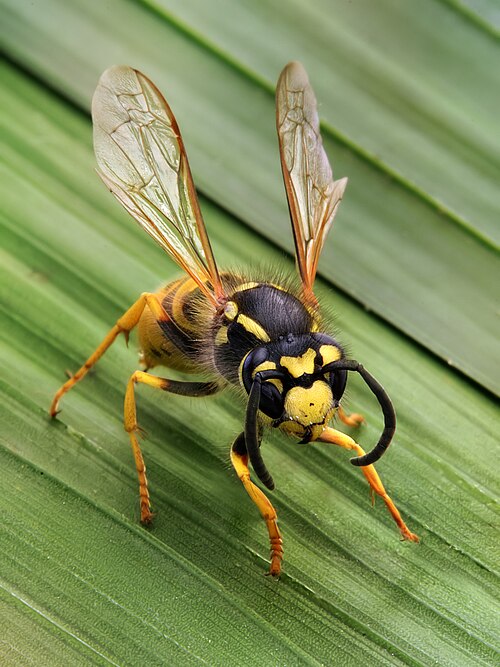
wasps
members of the order Hymenoptera
Wikipedia Q9458574 where this came from — the thing this word names — wasps
A wasp is any insect of the narrow-waisted suborder Apocrita of the order Hymenoptera which is neither a bee nor an ant; this excludes the broad-waisted sawflies (Symphyta), which look somewhat like wasps, but are in a separate suborder. The wasps do not constitute a clade, a complete natural group with a single ancestor, as bees and ants are deeply nested within the wasps, having evolved from wasp ancestors.
… 2,508 more Fold this article
Wasps that are members of the clade Aculeata can sting their prey.
The most commonly known wasps, such as yellowjackets and hornets, are in the family Vespidae and are eusocial, living together in a nest with an egg-laying queen and non-reproducing workers. Eusociality is favoured by the unusual haplodiploid system of sex determination in Hymenoptera, as it makes sisters exceptionally closely related to each other. However, the majority of wasp species are solitary, with each adult female living and breeding independently. Females typically have an ovipositor for laying eggs in or near a food source for the larvae, though in the Aculeata the ovipositor is often modified instead into a sting used for defense or prey capture.
Wasps play many ecological roles. Some are predators or pollinators, whether to feed themselves or to provision their nests. Many, notably the cuckoo wasps, are kleptoparasites, laying eggs in the nests of other wasps. Many of the solitary wasps are parasitoidal, meaning they lay eggs on or in other insects (any life stage from egg to adult) and often provision their own nests with such hosts. Unlike true parasites, the wasp larvae eventually kill their hosts. Solitary wasps parasitize almost every pest insect, making wasps valuable in horticulture for biological pest control of species such as whitefly in tomatoes and other crops.
Wasps first appeared in the fossil record in the Jurassic, and diversified into many surviving superfamilies by the Cretaceous. They are a successful and diverse group of insects with tens of thousands of described species; wasps have spread to all parts of the world except for the polar regions. The largest social wasp is the Asian giant hornet, at up to 5 centimetres (2.0 in) in length; among the largest solitary wasps is a group of species known as tarantula hawks, along with the giant scoliid of Indonesia (Megascolia procer). The smallest wasps are solitary parasitoid wasps in the family Mymaridae, including the world's smallest known insect, with a body length of only 0.139 mm (0.0055 in), and the smallest known flying insect, only 0.15 mm (0.0059 in) long.
Wasps have appeared in literature from Classical times, as the eponymous chorus of old men in Aristophanes' 422 BC comedy The Wasps, and in science fiction from H. G. Wells's 1904 novel The Food of the Gods and How It Came to Earth, featuring giant wasps with three-inch-long stings. The name 'Wasp' has been used for many warships and other military equipment.
 Wikipedia (English)
read this at Wikipedia (English)
where this came from — Wikipedia (English)
a kind of metabola Eumetabola Neoptera Metapterygota pterygote Dicondylia insect class Hexapoda
may also refer to
- wasps — members of the order Hymenoptera
Public linked claims
What the existing sources assert about these meanings. These are source claims, not curated endorsements.
-
wasp lexeme entity candidate wasps
Wikipedia (English) · assertion revision 1446044
Source, evidence and revision history -
social or solitary hymenopterans typically having a slender body with the abdomen attached by a narrow stalk and having a formidable sting refers to wasps
Wikipedia (English) · assertion revision 4348166
Source, evidence and revision history
Sources
-
Samuel Johnson, A Dictionary of the English Language
Samuel Johnson
-
 Wikidata
-
Wikipedia (English)
Wikipedia (English)
-
Wiktionary (English) via Kaikki
Wiktionary (English) via Kaikki
-
Open English WordNet 2025
Open English WordNet 2025
-
GIPHY
GIPHY
-
Urban Dictionary
Urban Dictionary
7 sources on this page