All materials · Bivalvia
Search the dictionaries, texts, images and API records available for this entry. Source matches are not curated endorsements.
Return to the curated articleSource / API coverage for this entry
Counts above cover loaded, permitted materials. Unavailable or not-yet-loaded sources are not evidence of an empty catalogue. Browser-only results remain on your device.
- Bing News · not loaded for this entry
- CineGraph · not loaded for this entry
- Wikimedia Commons · not loaded for this entry
- GIPHY · browser results · inspect complete records for status
- The Guardian · not loaded for this entry
- The Met · not loaded for this entry
- Open Library · not loaded for this entry
- Openverse · not loaded for this entry
- Pexels · not loaded for this entry
- PoetryDB · not loaded for this entry
- Spotify · not loaded for this entry
- Unsplash · not loaded for this entry
- Wikiquote · not loaded for this entry
Inspect complete source records and provider status
Definitions
1 dictionary
 Open English WordNet 2025
2025 ·
noun ·
1 sense
oysters, clams, scallops, mussels
Open English WordNet 2025
2025 · noun · 1 sense
oysters, clams, scallops, mussels
-
●
oysters, clams, scallops, musselsparts Anomiidae Arcidae Cardiidae Myaceae Mytilidae Ostreidae Pectinidae Pholadidae Placuna Pteriidae Teredinidae Tridacnidaepart of Mollusca
broader class taxonomic group biological group group abstraction entity
Read this at Open English WordNet 2025 where this came from — Open English WordNet 2025
 Urban Dictionary
read this at Urban Dictionary
Asking Urban Dictionary…
Crowd-sourced and unreviewed. Fetched by your browser; nothing is stored here.
Out in the world
every match says why it is here
GIFs
 GIPHY

Looking for GIFs…
Fetched by your browser on this visit; nothing is stored here.
Search matches, not reviewed interpretations. Hover, focus or press Play to animate.
Subjects
1 subject · 0 addressed
Found by name and by the sources. Not reviewed: a shared name is not a shared identity.
Subject
Bivalvia
class of molluscs
Unclassified
Bivalvia
class of molluscs
Bivalvia
Wikipedia Q25368 where this came from — the thing this word names — Bivalvia
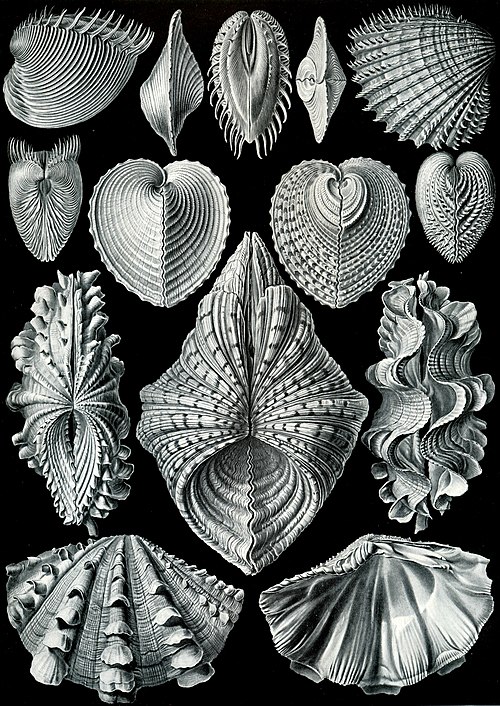
Bivalvia () or bivalves, in previous centuries referred to as the Lamellibranchiata and Pelecypoda, is a class of aquatic molluscs (marine and freshwater) that have laterally compressed soft bodies enclosed by a calcified exoskeleton consisting of a hinged pair of half-shells known as valves. As a group, bivalves have no head and lack some typical molluscan organs such as the radula and the odontophore.
… 2,678 more Fold this article
Their gills have evolved into ctenidia, specialised organs for feeding and breathing.
Common bivalves include clams, oysters, cockles, mussels, scallops, and numerous other families that live in saltwater, as well as a number of families that live in freshwater. Majority of the class are benthic filter feeders that bury themselves in sediment, where they are relatively safe from predation. Others lie on the sea floor or attach themselves to rocks or other hard surfaces. Some bivalves, such as scallops and file shells, can swim. Shipworms bore into wood, clay, or stone and live inside these substances.
The shell of a bivalve is composed of calcium carbonate, and consists of two, usually similar, parts called valves. These valves are for feeding and for disposal of waste. These are joined together along one edge (the hinge line) by a flexible ligament that, usually in conjunction with interlocking "teeth" on each of the valves, forms the hinge. This arrangement allows the shell to be opened and closed without the two halves detaching. The shell is typically bilaterally symmetrical, with the hinge lying in the sagittal plane. Adult shell sizes of bivalves vary from fractions of a millimetre to over a metre in length, but the majority of species do not exceed 10 cm (4 in).
Bivalves have long been a part of the diet of coastal and riparian human populations. Oysters were cultured in ponds by the Romans, and mariculture has more recently become an important source of bivalves for food. Modern knowledge of molluscan reproductive cycles has led to the development of hatcheries and new culture techniques. A better understanding of the potential hazards of eating raw or undercooked shellfish has led to improved storage and processing. Pearl oysters (the common name of two very different families in salt water and fresh water) are the most common source of natural pearls. The shells of bivalves are used in craftwork, and the manufacture of jewellery and buttons. Bivalves have also been used in the biocontrol of pollution.
Bivalves appear in the fossil record first in the early Cambrian more than 500 million years ago. The total number of known living species is about 9,200. These species are placed within 1,260 genera and 106 families. Marine bivalves (including brackish water and estuarine species) represent about 8,000 species, combined in four subclasses and 99 families with 1,100 genera. The largest recent marine families are the Veneridae, with more than 680 species and the Tellinidae and Lucinidae, each with over 500 species. The freshwater bivalves include seven families, the largest of which are the Unionidae, with about 700 species.
 Wikipedia (English)
read this at Wikipedia (English)
where this came from — Wikipedia (English)
a kind of phylum Mollusca lophotrochozoan spiralian protostome bilaterian ParaHoxozoa eumetazoan animal
may also refer to
- Bivalvia — class of molluscs
Public linked claims
What the existing sources assert about these meanings. These are source claims, not curated endorsements.
-
Bivalvia lexeme entity candidate Bivalvia
Wikipedia (English) · assertion revision 1480523
Source, evidence and revision history -
oysters, clams, scallops, mussels refers to Bivalvia
Open English WordNet 2025 · assertion revision 4367955
Source, evidence and revision history -
oysters, clams, scallops, mussels refers to Bivalvia
Open English WordNet 2025 · assertion revision 4368642
Source, evidence and revision history
Sources
-
 Wikidata
-
Wikipedia (English)
Wikipedia (English)
-
Open English WordNet 2025
Open English WordNet 2025
-
GIPHY
GIPHY
-
Urban Dictionary
Urban Dictionary
5 sources on this page