All materials · tadpole
Search the dictionaries, texts, images and API records available for this entry. Source matches are not curated endorsements.
Return to the curated articleSource / API coverage for this entry
Counts above cover loaded, permitted materials. Unavailable or not-yet-loaded sources are not evidence of an empty catalogue. Browser-only results remain on your device.
- Bing News · not loaded for this entry
- CineGraph · not loaded for this entry
- Wikimedia Commons · not loaded for this entry
- GIPHY · browser results · inspect complete records for status
- The Guardian · not loaded for this entry
- The Met · not loaded for this entry
- Open Library · not loaded for this entry
- Openverse · not loaded for this entry
- Pexels · not loaded for this entry
- PoetryDB · not loaded for this entry
- Spotify · not loaded for this entry
- Unsplash · not loaded for this entry
- Wikiquote · not loaded for this entry
Inspect complete source records and provider status
Definitions
3 dictionaries
 Samuel Johnson
18th century ·
1755 ·
noun ·
523 characters
A young shapeless frog or toad, consisting only of a body and a tail; a porwiggle. I'll broach the tadpole on my rapier's point. Shakespeare. Poor Tom eats the toad and the tadpole. Shakespeare. The result is not a perfe
Samuel Johnson
18th century · 1755 · noun · 523 characters
A young shapeless frog or toad, consisting only of a body and a tail; a porwiggle. I'll broach the tadpole on my rapier's point. Shakespeare. Poor Tom eats the toad and the tadpole. Shakespeare. The result is not a perfe
A young shapeless frog or toad, consisting only of a body and a tail; a porwiggle.
I'll broach the tadpole on my rapier's point. Shakespeare.
Poor Tom eats the toad and the tadpole. Shakespeare.
The result is not a perfect frog but a tadpole, without any
feet, and having a long tail to swim with. Ray.
A black and round substance began to dilate, and after
awhile the head, the eyes, the tail to be discernable, and at
last become what the ancients called gyrinus, we a porwigle
or tadpole. Brown's Vulgar Errours, b. iii.
Read this at Samuel Johnson where this came from — Samuel Johnson, A Dictionary of the English Language
 Open English WordNet 2025
2025 ·
noun ·
1 sense
a larval frog or toad
Open English WordNet 2025
2025 · noun · 1 sense
a larval frog or toad
-
●
a larval frog or toadpart of amphibia
broader larva animal organism living thing whole object physical entity entity
Read this at Open English WordNet 2025 where this came from — Open English WordNet 2025
 Wiktionary (English) via Kaikki
2026 ·
noun ·
6 senses
A young toad or frog in its larval stage of development that lives in water, has a tail and no legs, and, like a fish, breathes through gills.
Wiktionary (English) via Kaikki
2026 · noun · 6 senses
A young toad or frog in its larval stage of development that lives in water, has a tail and no legs, and, like a fish, breathes through gills.
-
1
A young toad or frog in its larval stage of development that lives in water, has a tail and no legs, and, like a fish, breathes through gills.
-
2
The aquatic larva of any amphibian. (broadly)
-
3
A type of cargo bike that has two wheels in front and one in back.
show 3 more
-
4
A child's basic drawing of a human being, having a detailed head but only sticks for the body and limbs.
-
5
A small child. (informal)
-
“Shouldn't you tadpoles be in bed?”
1970, Dorothy Clarke Wilson, Lone Woman, page 174
Wiktionary (English) via Kaikki
Plausible
-
-
6
An insignificant person. (derogatory, informal)
-
“Woman's voice: You impudent imp! You tadpole! You shrimp!”
1900 August 4, The Geelong Advertiser, Victoria, page 6, column 7
Wiktionary (English) via Kaikki
Plausible
-
““[H]ere's this Tooralooral tadpole of a Mayor shovin' his nose into the business and arrestin' our Puddin' without rhyme or reason.””
1918, Norman Lindsay, The Magic Pudding, page 142
Wiktionary (English) via Kaikki
Plausible
-
Read this at Wiktionary (English) via Kaikki where this came from — Wiktionary (English) via Kaikki
 Urban Dictionary
read this at Urban Dictionary
Asking Urban Dictionary…
Crowd-sourced and unreviewed. Fetched by your browser; nothing is stored here.
Out in the world
every match says why it is here
GIFs
 GIPHY

Looking for GIFs…
Fetched by your browser on this visit; nothing is stored here.
Search matches, not reviewed interpretations. Hover, focus or press Play to animate.
Subjects
1 subject · 0 addressed
Found by name and by the sources. Not reviewed: a shared name is not a shared identity.
Subject
tadpole
larva of amphibians
Unclassified
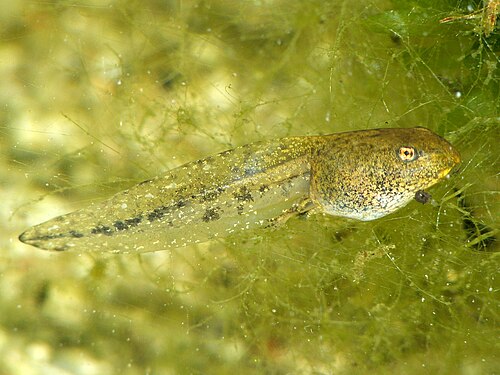
tadpole
larva of amphibians
Wikipedia Q168525 where this came from — the thing this word names — tadpole
A tadpole or polliwog (also porwigle) is the larval stage in the biological life cycle of an amphibian. Most tadpoles are fully aquatic, though some species of amphibians have tadpoles that are terrestrial. Tadpoles have some fish-like features that may not be found in adult amphibians, such as a lateral line, gills and swimming tails. As they undergo metamorphosis, they start to develop functional lungs for breathing air, and the diet of tadpoles changes drastically.
… 715 more Fold this article
A few amphibians, such as some members of the frog family Brevicipitidae, undergo direct development – i.e., they do not undergo a free-living larval stage as tadpoles – instead emerging from eggs as fully formed "froglet" miniatures of the adult morphology. Some other species hatch into tadpoles underneath the skin of the female adult or are kept in a pouch until after metamorphosis. Having no hard skeletons, it might be expected that tadpole fossils would not exist. However, traces of biofilms have been preserved and fossil tadpoles have been found dating back to the Middle Jurassic.
Tadpoles are eaten as human food in some parts of the world and are mentioned in various folk tales from around the world.
 Wikipedia (English)
read this at Wikipedia (English)
where this came from — Wikipedia (English)
a kind of amphibian batrachomorph Tetrapoda Stegocephalia fishapod eotetrapodiform tetrapodomorph Dipnotetrapodomorpha
may also refer to
- tadpole — larva of amphibians
Public linked claims
What the existing sources assert about these meanings. These are source claims, not curated endorsements.
-
tadpole lexeme entity candidate tadpole
Wikipedia (English) · assertion revision 1446645
Source, evidence and revision history -
A young toad or frog in its larval stage of development that lives in water, has a tail and no legs, and, like a fish, breathes through gills. refers to tadpole
Wikipedia (English) · assertion revision 4347722
Source, evidence and revision history
Sources
-
Samuel Johnson, A Dictionary of the English Language
Samuel Johnson
-
 Wikidata
-
Wikipedia (English)
Wikipedia (English)
-
Wiktionary (English) via Kaikki
Wiktionary (English) via Kaikki
-
Open English WordNet 2025
Open English WordNet 2025
-
GIPHY
GIPHY
-
Urban Dictionary
Urban Dictionary
7 sources on this page