All materials · demon
Search the dictionaries, texts, images and API records available for this entry. Source matches are not curated endorsements.
Return to the curated articleSource / API coverage for this entry
Counts above cover loaded, permitted materials. Unavailable or not-yet-loaded sources are not evidence of an empty catalogue. Browser-only results remain on your device.
- Bing News · not loaded for this entry
- CineGraph · not loaded for this entry
- Wikimedia Commons · not loaded for this entry
- GIPHY · browser results · inspect complete records for status
- The Guardian · not loaded for this entry
- The Met · not loaded for this entry
- Open Library · not loaded for this entry
- Openverse · not loaded for this entry
- Pexels · not loaded for this entry
- PoetryDB · not loaded for this entry
- Spotify · not loaded for this entry
- Unsplash · not loaded for this entry
- Wikiquote · not loaded for this entry
Inspect complete source records and provider status
demon
noun
mythological and malevolent being prevalent in religion, occultism, mythology, and folklore Wikidata where this came from — Wikidata
Definitions
3 dictionaries
 Samuel Johnson
18th century ·
1755 ·
noun ·
174 characters
A spirit; generally an evil spirit; a devil. I felt him strike, and now I see him fly: Curs'd demon! O for ever broken lie Those fatal shafts, by which I inward bleed. Prior.
Samuel Johnson
18th century · 1755 · noun · 174 characters
A spirit; generally an evil spirit; a devil. I felt him strike, and now I see him fly: Curs'd demon! O for ever broken lie Those fatal shafts, by which I inward bleed. Prior.
A spirit; generally an evil spirit; a devil.
I felt him strike, and now I see him fly:
Curs'd demon! O for ever broken lie
Those fatal shafts, by which I inward bleed. Prior.
Read this at Samuel Johnson where this came from — Samuel Johnson, A Dictionary of the English Language
 Open English WordNet 2025
2025 ·
noun ·
3 senses
someone extremely diligent or skillful
Open English WordNet 2025
2025 · noun · 3 senses
someone extremely diligent or skillful
-
●
someone extremely diligent or skillful
broader actor causal agent physical entity entity
- ●
broader evil spirit spirit spiritual being belief content cognition psychological feature abstraction
-
●
a cruel wicked and inhuman personnarrower demoniac
broader unpleasant person unwelcome person actor causal agent physical entity entity
Read this at Open English WordNet 2025 where this came from — Open English WordNet 2025
 Wiktionary (English) via Kaikki
2026 ·
noun ·
14 senses
Alternative spelling of daemon.
Wiktionary (English) via Kaikki
2026 · noun · 14 senses
Alternative spelling of daemon.
-
1
Alternative spelling of daemon. (alt-of, alternative)variants daemon
-
2
An evil being resident in or working for Hell; a devil.
-
“So what does the Gospel of Judas really say? It says that Judas is a specific demon called the "Thirteenth." In certain Gnostic traditions, this is the given name of the king of demons - an entity known as Ialdabaoth who lives in the 13th realm above the earth. Judas is his human alter ego, his undercover agent in the world. These Gnostics equated Ialdabaoth with the Hebrew Yahweh, whom they saw as a jealous and wrathful deity and an opponent of the supreme God whom Jesus came to earth to reveal. Whoever wrote the Gospel of Judas was a harsh critic of mainstream Christianity and its rituals. Because Judas is a demon working for Ialdabaoth, the author believed, when Judas sacrifices Jesus he does so to the demons, not to the supreme God. This mocks mainstream Christians' belief in the atoning value of Jesus' death and in the effectiveness of the Eucharist.”
2007 December 2, April D. DeConick, “What the Gospel of Judas really says”, in The New York Times, →ISSN, →OCLC, archived from the original on 23 Nov 2011, Essay
Wiktionary (English) via Kaikki
Plausible
-
-
3
Acronym of distinct electron motion particle: a quasiparticle, a type of massless neutral electron excitation associated with superconductivity. (abbreviation, acronym, alt-of)
show 11 more
-
4
A false god or idol; a Satanic divinity. (historical)
-
5
A very wicked or malevolent person; also (in weakened sense) a mischievous person, especially a child. (broadly, figuratively)
-
6
A source (especially personified) of great evil or wickedness; a destructive feeling or character flaw.
-
7
A person's fears or anxieties. (in-plural)
-
“After a short spell on an adult psychiatric ward, she decided to find her own way to deal with her demons.”
2013 January 21, The Guardian
Wiktionary (English) via Kaikki
Plausible
-
-
8
A person's inner spirit or genius; a guiding or creative impulse.
-
“Oh Anthony […] Thy Dæmon that thy spirit which keepes thee, is Noble, Couragious, high vnmatchable.”
c. 1606–1607 (date written), William Shakespeare, “The Tragedie of Anthonie and Cleopatra”, in Mr. William Shakespeares Comedies, Histories, & Tragedies […] (First Folio), London: […] Isaac Iaggard, and Ed[ward] Blount, published 1623, →OCLC, [Act II, scene iii]
Wiktionary (English) via Kaikki
Plausible
-
““You saw her. And I picked her up,” Lyra said, blushing, because of course it was a gross violation of manners to touch something so private as someone else's dæmon.”
2000, Phillip Pullman, The Amber Spyglass
Wiktionary (English) via Kaikki
Plausible
-
-
9
A tutelary deity or spirit intermediate between the major Olympian gods and mankind, especially a deified hero or the entity which supposedly guided Socrates, telling him what not to do. (Greek)
-
10
A supernatural being not considered to be inherently evil; a (non-Christian) deity.
-
11
A hypothetical entity with special abilities postulated for the sake of a thought experiment in philosophy or physics.
-
“Let the orders now be that each demon is to stop all molecules from crossing his area in either direction except 100 coming from A, arbitrarily chosen to be let pass into B, and a greater number, having among them less energy but equal momentum, to cross from B to A.”
1874, William Thomson, 1st Baron Kelvin, “Kinetic Theory of the Dissipation of Energy” in Nature 9, 441-444
Wiktionary (English) via Kaikki
Plausible
-
-
12
Someone with great strength, passion or skill for a particular activity, pursuit etc.; an enthusiast.
-
“Chelsea defended like demons to snuff out Manchester City but this was a perfectly calibrated triumph, built upon a structured attacking approach, choosing the right moments to transition, and illuminated by the smoothness of Havertz’s technique.”
2021 May 29, David Hytner, “Chelsea win Champions League after Kai Havertz stuns Manchester City”, in The Guardian, archived from the original on 28 Aug 2021
Wiktionary (English) via Kaikki
Plausible
-
-
13
A type of patience or solitaire (card game) played in the UK and/or US.
-
“‘That's much the best feeling to have.’ She dealt out the first row of ‘demon’.”
1924, EM Forster, A Passage to India, Penguin, published 2005, page 89
Wiktionary (English) via Kaikki
Plausible
similar Canfield -
-
14
Any of various hesperiid butterflies of the genera Notocrypta and Udaspes.
Read this at Wiktionary (English) via Kaikki where this came from — Wiktionary (English) via Kaikki
Examples
1 named by the record
-
1
filed as an instance of demon by
 Wikidata
, none of them a word yet
 Urban Dictionary
read this at Urban Dictionary
Asking Urban Dictionary…
Crowd-sourced and unreviewed. Fetched by your browser; nothing is stored here.
Out in the world
10 things · every match says why it is here
Artworks
10
Saved catalog
-
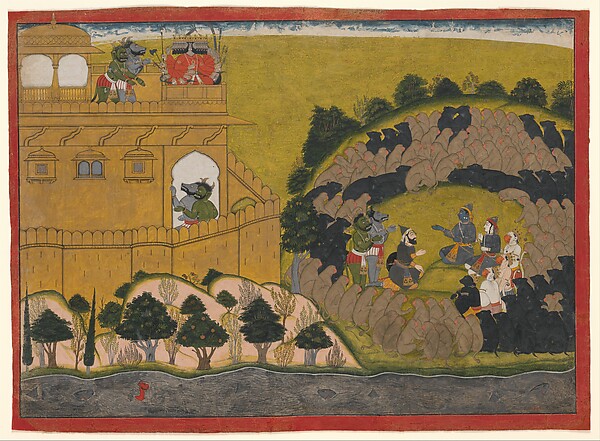
Rama Releases the Demon Spies Shuka and Sarana: Folio from the Siege of Lanka series
ca. 1725 Artwork
Manaku
Rogers Fund, 1919
Open at The Met -

The Goddess Durga Slaying the Demon Buffalo Mahisha
12th century Artwork
Purchase, Diana L. and Arthur G. Altschul Gift, 1993
Open at The Met -

The Demon Hiranyaksha Departs the Demon Palace: Folio from a Bhagavata Purana Series
ca. 1740 Artwork
Cynthia Hazen Polsky and Leon B. Polsky Fund, 2002
Open at The Met -

Top for standard
ca. 8th century BCE Artwork
Gift of Laura White and Fred Randolph, 1996
Open at The Met -

Shaft-hole axe head with bird-headed demon, boar, and dragon
ca. late 3rd–early 2nd millennium BCE Artwork
Purchase, Harris Brisbane Dick Fund, and James N. Spear and Schimmel Foundation Inc. Gifts, 1982
Open at The Met -
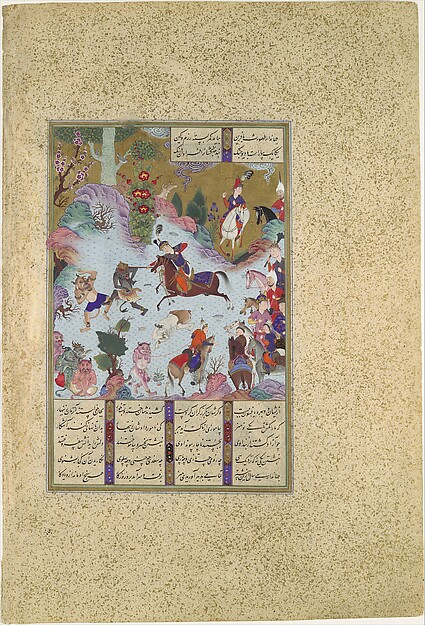
"Tahmuras Defeats the Divs", Folio 23v from the Shahnama (Book of Kings) of Shah Tahmasp
ca. 1525 Artwork
Abu'l Qasim Firdausi
Gift of Arthur A. Houghton Jr., 1970
Open at The Met -

The Right Hand of God Protecting the Faithful against the Demons
ca. 1452–60 Artwork
Jean Fouquet
Robert Lehman Collection, 1975
Open at The Met -
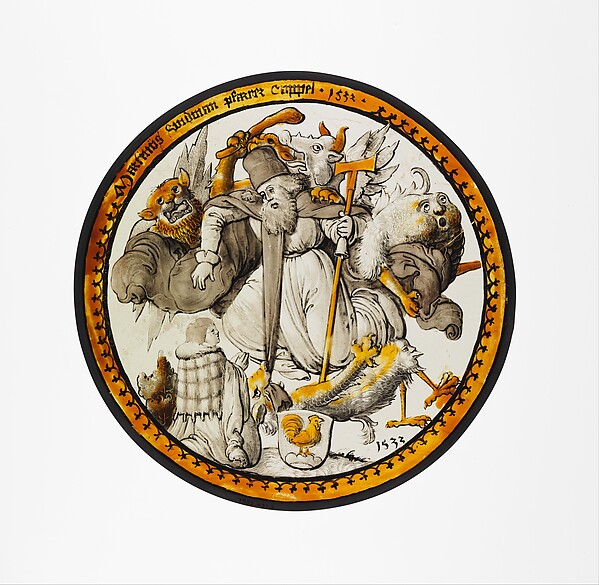
Roundel with the Temptation of Saint Anthony
1532 Artwork
The Cloisters Collection, 1982
Open at The Met -

Saint Anthony Abbot
ca. 1500 Artwork
Nikolaus von Hagenau
The Cloisters Collection, 1988
Open at The Met -

Goddess Durga Slaying the Demon Mahisha
second half of the 9th century Artwork
Purchase, Blanca and Sunil Hirani Gift, in honor of Sunita and Gordhan Hirani, 2016
Open at The Met
Held since 17 Sep 2026.
GIFs
 GIPHY

Looking for GIFs…
Fetched by your browser on this visit; nothing is stored here.
Search matches, not reviewed interpretations. Hover, focus or press Play to animate.
Matches for “demon” · About these results
Artworks
Saved catalog · The Met
Catalog matches from The Met, held locally rather than searched for on this visit. None is an accepted interpretation: a contributor connects an exact meaning and reviewers decide the claim. Browse saved artworks
- Rama Releases the Demon Spies Shuka and Sarana: Folio from the Siege of Lanka series: Direct depiction of “demon” (Q177413) tagged “Demons”. · not yet reviewed
- The Goddess Durga Slaying the Demon Buffalo Mahisha: Direct depiction of “demon” (Q177413) tagged “Demons”. · not yet reviewed
- The Demon Hiranyaksha Departs the Demon Palace: Folio from a Bhagavata Purana Series: Direct depiction of “demon” (Q177413) tagged “Demons”. · not yet reviewed
- Top for standard: Direct depiction of “demon” (Q177413) tagged “Demons”. · not yet reviewed
- Shaft-hole axe head with bird-headed demon, boar, and dragon: Direct depiction of “demon” (Q177413) tagged “Demons”. · not yet reviewed
- "Tahmuras Defeats the Divs", Folio 23v from the Shahnama (Book of Kings) of Shah Tahmasp: Direct depiction of “demon” (Q177413) tagged “Demons”. · not yet reviewed
- The Right Hand of God Protecting the Faithful against the Demons: Direct depiction of “demon” (Q177413) tagged “Demons”. · not yet reviewed
- Roundel with the Temptation of Saint Anthony: Direct depiction of “demon” (Q177413) tagged “Demons”. · not yet reviewed
- Saint Anthony Abbot: Direct depiction of “demon” (Q177413) tagged “Demons”. · not yet reviewed
- Goddess Durga Slaying the Demon Mahisha: Direct depiction of “demon” (Q177413) tagged “Demons”. · not yet reviewed
Subjects
1 subject · 0 addressed
Found by name and by the sources. Not reviewed: a shared name is not a shared identity.
Subject
demon
mythological and malevolent being prevalent in religion, occultism, mythology, and folklore
Unclassified

demon
mythological and malevolent being prevalent in religion, occultism, mythology, and folklore
Wikipedia Q177413 where this came from — the thing this word names — demon
A demon is an evil or malevolent supernatural entity, though they can be benevolent too. Historically, belief in demons, or stories about demons, occurs in folklore, mythology, religion, occultism, and literature; these beliefs are reflected in media including fiction, comics, film, television, and video games. Belief in demons probably goes back to the Paleolithic age, stemming from humanity's fear of the unknown, the strange and the horrific.
… 1,947 more Fold this article
In ancient Near Eastern religions and in the Abrahamic religions, including early Judaism and ancient-medieval Christian demonology, a demon is considered a harmful spiritual entity that may cause demonic possession, calling for an exorcism. Large portions of Jewish demonology, a key influence on Christianity and Islam, originated from a later form of Zoroastrianism, and was transferred to Judaism during the Persian era.
Demons may or may not be considered to be devils: minions of the Devil. In many traditions, demons are independent operators, with different demons causing different types of evils (destructive natural phenomena, specific diseases, etc.) in general, while devils appear more often as demons within a theological framework; demons opposing the Divine principle. As lesser spirits doing the Devil's work, they have additional duties—causing humans to have sinful thoughts and tempting humans to commit sinful actions.
The original Ancient Greek word daimōn (δαίμων) did not carry negative connotations, as it denotes a spirit or divine power. The Greek conception of a daimōn notably appears in the philosophical works of Plato, where it describes the divine inspiration of Socrates. In Christianity, morally ambivalent daimōn were replaced by demons, forces of evil only striving for corruption. Such demons are not the Greek intermediary spirits, but hostile entities, already known in Iranian beliefs. In Western esotericism and Renaissance magic, which grew out of an amalgamation of Greco-Roman magic, Jewish Aggadah, and Christian demonology, a demon is believed to be a spiritual entity that may be conjured and controlled.
Belief in demons remains an important part of many modern religions and occult traditions. Demons are still feared largely due to their alleged power to possess living creatures. Within a psychological context demons may be used as metaphors for inner psychological processes ("inner demons").
 Wikipedia (English)
read this at Wikipedia (English)
where this came from — Wikipedia (English)
a kind of mythical monster
may also refer to
- demon — mythological and malevolent being prevalent in religion, occultism, mythology, and folklore
Public linked claims
What the existing sources assert about these meanings. These are source claims, not curated endorsements.
-
Māra Pāpīyān instance of demon
Wikidata · assertion revision 1225369
Source, evidence and revision history -
demon lexeme entity candidate demon
Wikipedia (English) · assertion revision 1444150
Source, evidence and revision history -
A supernatural being not considered to be inherently evil; a (non-Christian) deity. refers to demon
Wikipedia (English) · assertion revision 4344175
Source, evidence and revision history
Sources
-
Samuel Johnson, A Dictionary of the English Language
Samuel Johnson
-
 The Met
-
Wikidata
Wikidata
-
Wikipedia (English)
Wikipedia (English)
-
Wiktionary (English) via Kaikki
Wiktionary (English) via Kaikki
-
Open English WordNet 2025
Open English WordNet 2025
-
GIPHY
GIPHY
-
Urban Dictionary
Urban Dictionary
8 sources on this page