All materials · earwig
Search the dictionaries, texts, images and API records available for this entry. Source matches are not curated endorsements.
Return to the curated articleSource / API coverage for this entry
Counts above cover loaded, permitted materials. Unavailable or not-yet-loaded sources are not evidence of an empty catalogue. Browser-only results remain on your device.
- Bing News · not loaded for this entry
- CineGraph · not loaded for this entry
- Wikimedia Commons · not loaded for this entry
- GIPHY · browser results · inspect complete records for status
- The Guardian · not loaded for this entry
- The Met · not loaded for this entry
- Open Library · not loaded for this entry
- Openverse · not loaded for this entry
- Pexels · not loaded for this entry
- PoetryDB · not loaded for this entry
- Spotify · not loaded for this entry
- Unsplash · not loaded for this entry
- Wikiquote · not loaded for this entry
Inspect complete source records and provider status
Definitions
3 dictionaries
 Samuel Johnson
18th century ·
1755 ·
noun ·
420 characters
A sheathwinged insect, imagined to creep into the ear. Himself he on an earwig set; Yet scarce he on his back could get, So oft and high he did curvet. Drayton's Nymphid. Earwigs and snails seldom insect timber. Mortimer
Samuel Johnson
18th century · 1755 · noun · 420 characters
A sheathwinged insect, imagined to creep into the ear. Himself he on an earwig set; Yet scarce he on his back could get, So oft and high he did curvet. Drayton's Nymphid. Earwigs and snails seldom insect timber. Mortimer
A sheathwinged insect, imagined to creep into the ear.
Himself he on an earwig set;
Yet scarce he on his back could get,
So oft and high he did curvet. Drayton's Nymphid.
Earwigs and snails seldom insect timber. Mortimer's Husb.
Doll never flies to cut her lace,
Or throw cold water in her face,
Because she heard a sudden drum,
Or found an earwig in a plum. Swift.
2. By way of reproach, a whisperer; a prying informer.
Read this at Samuel Johnson where this came from — Samuel Johnson, A Dictionary of the English Language
 Open English WordNet 2025
2025 ·
noun ·
1 sense
any of numerous insects of the order Dermaptera having elongate bodies and slender many-jointed antennae and a pair of large pincers at the rear of the abdomen
Open English WordNet 2025
2025 · noun · 1 sense
any of numerous insects of the order Dermaptera having elongate bodies and slender many-jointed antennae and a pair of large pincers at the rear of the abdomen
-
●
any of numerous insects of the order Dermaptera having elongate bodies and slender many-jointed antennae and a pair of large pincers at the rear of the abdomennarrower Forficula auriculariapart of Dermaptera
broader insect arthropod invertebrate animal organism living thing whole object
Read this at Open English WordNet 2025 where this came from — Open English WordNet 2025
 Wiktionary (English) via Kaikki
2026 ·
noun ·
3 senses
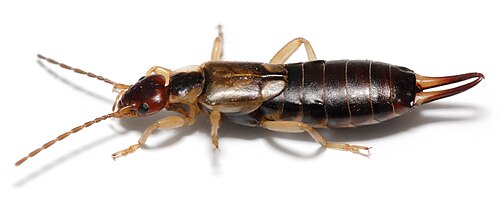
Any of various insects of the order Dermaptera that have elongated bodies, large membranous wings folded underneath short leathery forewings and a pair of large pincers protruding from the rear of the abdomen.
Wiktionary (English) via Kaikki
2026 · noun · 3 senses
Any of various insects of the order Dermaptera that have elongated bodies, large membranous wings folded underneath short leathery forewings and a pair of large pincers protruding from the rear of the abdomen.
-
1
Any of various insects of the order Dermaptera that have elongated bodies, large membranous wings folded underneath short leathery forewings and a pair of large pincers protruding from the rear of the abdomen.
-
“"That's a fine young fellow," said the historiographer of earwigs, to an American who stood next him in the crowd.”
1856, L. S. Lavenu, chapter XVII, in Erlesmere; or, Contrasts of Character, volume 1, London: Smith, Elder & Co., page 171
Wiktionary (English) via Kaikki
Plausible
-
“The idea was probably strengthened by the earwig′s appearance, with a sharp, pincer-like appendage extending to the rear. However, earwigs are herbivores, and they are no more likely to enter an ear than are ants, bees, flies, or any other small insect. Even when earwigs do occasionally find their way into human ears, they cannot burrow their way through the skin and into the brain.”
2001, Jan Harold Brunvand, Encyclopedia of Urban Legends, page 128
Wiktionary (English) via Kaikki
Plausible
-
-
2
One who whispers insinuations; a secret counsellor.
-
“That gawdy earwig, or my lord your patron, Whose pensioner you are.”
1633, John Ford (dramatist), The Broken Heart
Wiktionary (English) via Kaikki
Plausible
-
-
3
A flatterer.
Read this at Wiktionary (English) via Kaikki where this came from — Wiktionary (English) via Kaikki
 Urban Dictionary
read this at Urban Dictionary
Asking Urban Dictionary…
Crowd-sourced and unreviewed. Fetched by your browser; nothing is stored here.
Out in the world
every match says why it is here
GIFs
 GIPHY

Looking for GIFs…
Fetched by your browser on this visit; nothing is stored here.
Search matches, not reviewed interpretations. Hover, focus or press Play to animate.
Subjects
1 subject · 0 addressed
Found by name and by the sources. Not reviewed: a shared name is not a shared identity.
Subject
Dermaptera
order of insects
Unclassified
Dermaptera
order of insects
Dermaptera
Wikipedia Q13676 where this came from — the thing this word names — Dermaptera
Earwigs make up the insect order Dermaptera. With about 2,000 species in 12 families, they are one of the smaller insect orders. Earwigs have characteristic cerci, a pair of forceps-like pincers on their abdomen, and membranous wings folded underneath short, rarely used forewings, hence the scientific order name, "skin wings". Some groups are tiny parasites on mammals and lack the typical pincers.
… 1,209 more Fold this article
Earwigs are found on all continents except Antarctica.
Earwigs are mostly nocturnal and often hide in small, moist crevices during the day, and are active at night, feeding on a wide variety of insects and plants. Damage to foliage, flowers, and various crops is commonly blamed on earwigs, especially the common earwig Forficula auricularia.
Earwigs have five molts in the year before they become adults. Many earwig species display maternal care, which is uncommon among insects. Female earwigs may care for their eggs; the ones that do will continue to watch over nymphs until their second molt. As the nymphs molt, sexual dimorphism such as differences in pincer shapes begins to show.
Extant Dermaptera belong to the suborder Neodermaptera, which first appeared during the Cretaceous. Some earwig specimen fossils are placed with extinct suborders Archidermaptera or Eodermaptera, the former dating to the Late Triassic and the latter to the Middle Jurassic. Dermaptera belongs to the major grouping Polyneoptera, and are amongst the earliest diverging members of the group, alongside angel insects (Zoraptera), and stoneflies (Plecoptera), but the exact relationship among the three groups is uncertain.
 Wikipedia (English)
read this at Wikipedia (English)
where this came from — Wikipedia (English)
a kind of Haplocercata orthopteroid Neoptera Metapterygota pterygote Dicondylia insect class Hexapoda
may also refer to
- Dermaptera — order of insects
Public linked claims
What the existing sources assert about these meanings. These are source claims, not curated endorsements.
-
earwig lexeme entity candidate Dermaptera
Wikipedia (English) · assertion revision 1444302
Source, evidence and revision history -
Any of various insects of the order Dermaptera that have elongated bodies, large membranous wings folded underneath short leathery forewings and a pair of large pincers protruding from the rear of the abdomen. refers to Dermaptera
Wikipedia (English) · assertion revision 4344355
Source, evidence and revision history
Sources
-
Samuel Johnson, A Dictionary of the English Language
Samuel Johnson
-
 Wikidata
-
Wikipedia (English)
Wikipedia (English)
-
Wiktionary (English) via Kaikki
Wiktionary (English) via Kaikki
-
Open English WordNet 2025
Open English WordNet 2025
-
GIPHY
GIPHY
-
Urban Dictionary
Urban Dictionary
7 sources on this page