All materials · prey
Search the dictionaries, texts, images and API records available for this entry. Source matches are not curated endorsements.
Return to the curated articleSource / API coverage for this entry
Counts above cover loaded, permitted materials. Unavailable or not-yet-loaded sources are not evidence of an empty catalogue. Browser-only results remain on your device.
- Bing News · idle · 0 loaded
- CineGraph · idle · 0 loaded
- Wikimedia Commons · idle · 0 loaded
- GIPHY · browser results · inspect complete records for status
- The Guardian · idle · 0 loaded
- The Met · idle · 0 loaded
- Open Library · idle · 0 loaded
- Openverse · idle · 0 loaded
- Pexels · idle · 0 loaded
- PoetryDB · idle · 0 loaded
- Spotify · idle · 0 loaded
- Unsplash · idle · 0 loaded
- Wikiquote · idle · 0 loaded
Inspect complete source records and provider status
prey
noun
biological interaction where a predator feeds on a prey organism Wikidata where this came from — Wikidata
Definitions
3 dictionaries
 Samuel Johnson
18th century ·
1755 ·
noun ·
766 characters
1. Something to be devoured; something to be seized; food gotten by violence; ravine; wealth gotten by violence; plunder. A garrison supported itself, by the prey it took from the neighbourhood of Aylesbury. Clarendon, b
Samuel Johnson
18th century · 1755 · noun · 766 characters
1. Something to be devoured; something to be seized; food gotten by violence; ravine; wealth gotten by violence; plunder. A garrison supported itself, by the prey it took from the neighbourhood of Aylesbury. Clarendon, b
1. Something to be devoured; something to be seized; food gotten by violence; ravine; wealth gotten by violence; plunder.
A garrison supported itself, by the prey it took from the
neighbourhood of Aylesbury. Clarendon, b. viii.
The whole included race his purpos'd prey. Milton.
She sees herself the monster's prey,
And feels her heart and intrails torn away. Dryden.
Read the rest of this entry · 394 characters Fold this entry
Pindar, that eagle, mounts the skies,
While virtue leads the noble way;
Too like a vulture Boileau flies,
Where sordid int'rest shews the prey. Prior.
2. Ravage; depredation.
Hog in sloth, fox in stealth, lion in prey. Shakesp.
3. Animal of prey, is an animal that lives on other animals.
There are men of prey, as well as beasts and birds of prey,
that live upon, and delight in blood. L'Estrange.
Read this at Samuel Johnson where this came from — Samuel Johnson, A Dictionary of the English Language
 Open English WordNet 2025
2025 ·
noun ·
2 senses
animal hunted or caught for food
Open English WordNet 2025
2025 · noun · 2 senses
animal hunted or caught for food
-
●
animal hunted or caught for food
broader animal organism living thing whole object physical entity entity
-
●
a person who is the aim of an attack (especially a victim of ridicule or exploitation) by some hostile person or influence
broader victim unfortunate actor causal agent physical entity entity
Read this at Open English WordNet 2025 where this came from — Open English WordNet 2025
 Wiktionary (English) via Kaikki
2026 ·
noun ·
6 senses
That which is or may be seized by animals to be devoured.
Wiktionary (English) via Kaikki
2026 · noun · 6 senses
That which is or may be seized by animals to be devoured.
-
1
That which is or may be seized by animals to be devoured. (countable, uncountable)
-
“Already sees herself the monster's prey.”
1700, [John] Dryden, “Theodore and Honoria, from Boccace”, in Fables Ancient and Modern; […], London: […] Jacob Tonson, […], →OCLC
Wiktionary (English) via Kaikki
Plausible
-
-
2
A person or thing given up as a victim. (countable, uncountable)
-
“[The helmsman] steered with no end of a swagger while you were by; but if he lost sight of you, he became instantly the prey of an abject funk […]”
1899 March, Joseph Conrad, “The Heart of Darkness”, in Blackwood’s Edinburgh Magazine, volume CLXV, number MI, New York, N.Y.: The Leonard Scott Publishing Company, […], →OCLC, part II
Wiktionary (English) via Kaikki
Plausible
-
“Being so inflexible, the railway was easy prey to road competition, and the arrival of unregulated lorry transport from farm fields to town centres quickly captured all locally generated business.”
2020 November 18, Howard Johnston, “The missing 'Lincs' and the sole survivor”, in Rail, page 58
Wiktionary (English) via Kaikki
Plausible
-
-
3
A living thing, usually an animal, that is eaten by another living thing. (countable, uncountable)
-
“The old lion perisheth for lack of prey.”
1611, The Holy Bible, […] (King James Version), London: […] Robert Barker, […], →OCLC, Job 4:2
Wiktionary (English) via Kaikki
Plausible
-
“Nonetheless, some insect prey take advantage of clutter by hiding in it. Earless ghost swift moths become “invisible” to echolocating bats by forming mating clusters close (less than half a meter) above vegetation and effectively blending into the clutter of echoes that the bat receives from the leaves and stems around them.”
2013 May-June, William E. Conner, “An Acoustic Arms Race”, in American Scientist, volume 101, number 3, pages 206–7
Wiktionary (English) via Kaikki
Plausible
-
show 3 more
-
4
Anything, such as goods, etc., taken or got by violence; something taken by force from an enemy in war. (archaic, countable, uncountable)
-
“And they brought the captiues, and the pray, and the spoile vnto Moses and Eleazar the Priest, and vnto the Congregation of the children of Israel, vnto the campe at the plaines of Moab, which are by Iordan neere Iericho.”
1611, The Holy Bible, […] (King James Version), London: […] Robert Barker, […], →OCLC, Numbers 31:12
Wiktionary (English) via Kaikki
Plausible
-
-
5
The act of devouring other creatures; ravage. (archaic, countable, uncountable)
-
“Hog in sloth, fox in stealth, […] lion in prey.”
c. 1603–1606, William Shakespeare, “The Tragedie of King Lear”, in Mr. William Shakespeares Comedies, Histories, & Tragedies […] (First Folio), London: […] Isaac Iaggard, and Ed[ward] Blount, published 1623, →OCLC, [Act III, scene iv]
Wiktionary (English) via Kaikki
Plausible
-
-
6
The victim of a disease. (countable, uncountable)
Read this at Wiktionary (English) via Kaikki where this came from — Wiktionary (English) via Kaikki
 Urban Dictionary
read this at Urban Dictionary
Asking Urban Dictionary…
Crowd-sourced and unreviewed. Fetched by your browser; nothing is stored here.
Out in the world
every match says why it is here
In film
Looking for matching film…
In artwork
Looking for matching artwork…
In images
Looking for matching images…
Looking for matching images…
Looking for matching images…
Looking for matching images…
In text
Looking for matching text…
Looking for matching text…
In quotes
Looking for matching quotes…
In news
Looking for matching news…
Looking for matching news…
In music
Looking for matching music…
GIFs
 GIPHY

Looking for GIFs…
Fetched by your browser on this visit; nothing is stored here.
Search matches, not reviewed interpretations. Hover, focus or press Play to animate.
Subjects
1 subject · 0 addressed
Found by name and by the sources. Not reviewed: a shared name is not a shared identity.
Subject
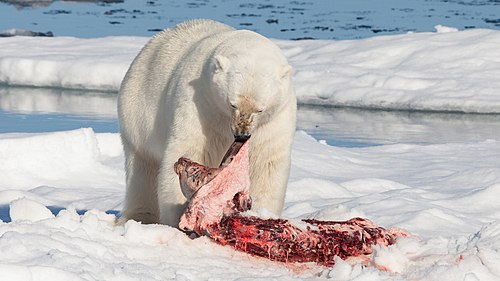
predation
biological interaction where a predator feeds on a prey organism
Unclassified
predation
biological interaction where a predator feeds on a prey organism
Wikipedia Q170430 where this came from — the thing this word names — predation
Predation is a biological interaction in which one organism, the predator, kills and eats another organism, its prey. The predator-prey relationship is one of a family of common feeding behaviours that includes parasitism and micropredation (which usually do not kill the host) and parasitoidism (which always does, eventually). It is distinct from scavenging on dead prey, though many predators also scavenge; it overlaps with herbivory, as seed predators and destructive frugivores are predators.
… 1,380 more Fold this article
Predation behaviour varies significantly depending on the organism. Many predators, especially carnivores, have evolved distinct hunting strategies. Pursuit predation involves the active search for and pursuit of prey, whilst ambush predators instead wait for prey to present an opportunity for capture, and often use stealth or aggressive mimicry to get close enough for a successful attack. Other predators are opportunistic or omnivorous and only practice predation occasionally.
Most obligate carnivores are specialized for hunting. They may have acute senses such as vision, hearing, or smell for prey detection. Many predatory animals have sharp claws or jaws to grip, kill, and cut up their prey. Physical strength is usually necessary for large carnivores such as big cats to kill larger prey. Other adaptations include stealth, endurance, intelligence, social behaviour, and aggressive mimicry that improve hunting efficiency.
Predation has a powerful selective effect on prey, and the prey develops anti-predator adaptations such as warning coloration, alarm calls and other signals, camouflage, mimicry of well-defended species, and defensive spines and chemicals. Sometimes predator and prey find themselves in an evolutionary arms race, a cycle of adaptations and counter-adaptations. Predation has been a major driver of evolution since at least the Cambrian period.
 Wikipedia (English)
read this at Wikipedia (English)
where this came from — Wikipedia (English)
may also refer to
- predation — biological interaction where a predator feeds on a prey organism
Public linked claims
What the existing sources assert about these meanings. These are source claims, not curated endorsements.
-
prey lexeme entity candidate predation
Wikipedia (English) · assertion revision 1444310
Source, evidence and revision history
Sources
-
Samuel Johnson, A Dictionary of the English Language
Samuel Johnson
-
 Wikidata
-
Wikipedia (English)
Wikipedia (English)
-
Wiktionary (English) via Kaikki
Wiktionary (English) via Kaikki
-
Open English WordNet 2025
Open English WordNet 2025
-
GIPHY
GIPHY
-
Urban Dictionary
Urban Dictionary
7 sources on this page